
Having compassion for vulnerable people feels natural. Having compassion for those with whom we do not agree can feel impossible. As we follow God’s call to love and serve all people, we rely on Jesus to guide us.
Further reading
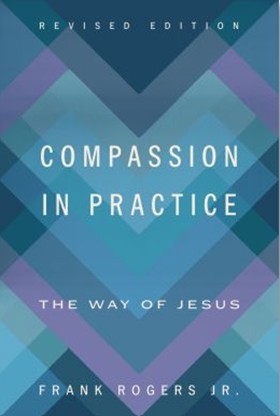
Learn to practice love and compassion for yourself and others in a world marred by conflict and violence in Compassion in Practice, The Way of Jesus, Revised Edition. Rogers added a decade of knowledge and understanding to the new edition. He says, “The need for compassion only deepens in our world.”
The book, available from Upper Room Books, focuses on the spiritual path of radical compassion that Jesus walked and taught, grounded in God's extravagant love for all people. This path transforms hardened hearts and brings healing and wholeness to even the most challenging situations.
Readers will find practices for self-compassion, social activism, and interfaith conversation, as well as spiritual exercises, a “compassion compass,” and more.
“Jesus was a spiritual teacher, and he was teaching a way of life that helped us to deeply connect with an extravagantly compassionate God, to offer self-compassion to ourselves that restores us to our best self, and to embody love and compassion in the world,” observes Frank Rogers, Jr., spiritual director, author, and professor.
Empathy leads to compassion
“Empathy is when we feel another person’s feelings. If we see someone in pain, we wince… Compassion is actually a shift from feeling another person’s pain to feeling a warm regard, that loving feeling towards a person whose pain we empathetically connect with,” says Rogers.
Both empathy and compassion can compel us to act. While empathy causes us to respond from the distress that we share with someone, compassion leads us to respond out of deep care for them.
Rogers explains, “If all we feel is empathy, we’re just going to get hardened inside. It’s too much to just feel people’s pain. We’re going to build up our own defenses.
“[Moving to compassion] involves taking time to pay attention to the other person and trying to see what their experience is. Then it’s a practice of accessing that warm, loving regard that’s in all of us and shifting that towards another human being.”
Radical care for everyone
“Jesus invited us to know a sacred presence that holds all of this planet in extravagant compassion,” Rogers notes. “The sun shines on the just and the unjust. There is a sacred reality that is sustaining every single human being that holds them with dignity and desires their well-being.
“We are invited to live a life that seeks to extend care towards other people – not just towards our kin or friends. It's also to have compassion for the people who are vulnerable, people who are marginalized, and people who are suffering.
Feel the PULSE of compassion
“When we are feeling compassionate, it's like our hearts are beating to the pulse of compassion, and neuroscience shows that our hearts do beat to different rhythms when we are in states of love as opposed to states of agitation or stress,” Rogers mentions.
Rogers teaches six dimensions of authentic compassion:
- Pay attention: Take the time to genuinely pay attention to the other person in their experience.
- Understand empathetically: Recognize the other person has fears they carry and that perhaps there is pain in their life.
- Love with connection: Access that warm, loving regard that genuinely cares about the well-being of the other person.
- Sense the sacred: Recognize that the other person is held by God with absolute love, care, and delight.
- Embody new life: Desire that the other person’s suffering will ease and that they will have new life.
- Moved to act: Respond with action to help restore the other person’s flourishing.
“But then Jesus stretches it even further. It's to have compassion even for the outcasts, for the people that our culture or social system wants to demonize or otherize.
“Then we even have compassion towards the people we would consider our enemies, people whose ideologies or actions we find abhorrent. Even the people who persecute us or who would bring abuse upon us.
“That's as hard as it gets. How do we not just say, ‘Okay, I'm supposed to do this so I'm going to grit my teeth. I really despise this person, but Jesus says we have to love them, so fine.’? How do we genuinely cultivate an ethic of radical care? That's the invitation.”
Overcome polarization with curiosity
As Jesus followers, we must find a way to have compassion and choose to connect with those who are different than us rather than demonize them. We can see them as someone with sacred worth and consider that their stance means they have something at stake which might be threatened.
Say to them, “You believe this passionately. Help me understand. What’s at stake? Whenever you are ready, tell me your story. I genuinely would like to know.” Treat them with humanity and care.
Rogers says, “It might take some befriending and being kind to them without talking to them about specific issues… When people approach others with compassion, curiosity, and humanity, that relaxes polarizations and deescalates tensions.”
Compassion for ourselves
Self-compassion is a vital part of the equation. We need to understand why we have strong reactions to others with whom we disagree, why we are threatened by them, or what pain we carry that influences our response to them.
We also have to balance the sacred worth of all people while holding people accountable for abuse and violence.
Once we are secure in our own truth, then we can begin to see the other person with a genuine curiosity and an openness to their humanity while remaining rooted in our own personal dignity.
Laura Buchanan works for UMC.org at United Methodist Communications. Contact her by email.
This story was published on May 18, 2026.


