
Faith isn’t abstract. It’s real. It’s embodied. It’s what we know in our hearts and minds and at a cellular level. Too often, Christians approach faith in an abstract way, confusing our heads with our hearts.
But Bishop Philip Otterbein knew better. He knew how to balance his head and his heart. He said in a sermon, “The question is not whether one has heard or learned something about Christ and his death…but whether one has experienced the death of Jesus Christ in putting to death and riddance the old (person)…Consequently, if these things are yet strange to you, then your Christianity is merely appearance.”
Get to know Otterbein
It was an ordinary June 3 in 1726 that an extraordinary man was born in Dillenburg, Germany. Philip William Otterbein, who typically went by his middle name or the moniker “Vater Otterbein” in his professional life, went on to become one of the founding bishops of the Church of the United Brethren in Christ in 1789, the first American-born denomination.
His work began decades earlier when he arrived in America as a German Reformed Church pastor and served in Frederick, Maryland, and Lancaster, Pennsylvania, before spending the last 39 years of his ministry in Baltimore, Maryland. His legacy was remembered by Francis Asbury in his eulogy for the German pastor as “the holy, the great Otterbein.”
A pilgrimage in honor of Bishop Otterbein
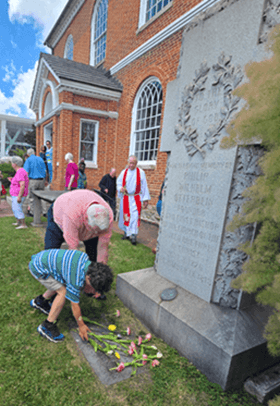
On June 6-7, 2026, the Baltimore-Washington Conference held a pilgrimage in honor of Philip Otterbein’s 300th birthday. In addition to lectures, learning about artifacts from the 2023 excavation of the Otterbein Church site, and fellowship, the pilgrims also explored Mt. Hebron and the Geeting House, two early sites of United Brethren heritage.
Pictured above are members of the congregation at Old Otterbein UMC placing flowers on Otterbein’s grave.
Learn more:
Otterbein once said, “If there is no Christ in us, there is also no Christ for us.” This is a line originally preached in 1760 from his only partially surviving sermon, as he burned his papers before he died. He had been married briefly to a woman named Susan, who died too young, and they never had any children.
“Forty years have I known the retiring majesty of this man of God, towering majestic above his fellows in learning, wisdom and grace, yet seeking to be known only of God and the people of God,” claimed Francis Asbury, the first American Methodist bishop, at Otterbein’s funeral. He continued, “There are few with whom I can find so much unity and freedom in conversation, as with Otterbein.”
Asbury’s connection
A strong personal friendship existed between Asbury and Otterbein, even surviving Otterbein's frank criticism of Asbury' s poetical efforts. The Methodist apostle wrote some religious verse which he showed his German brother before publishing, asking his opinion of it, to which Otterbein replied, "Brother Asbury, I don't think you was born a poet," and the verse was never printed.
When Asbury arrived in America in 1771, the German leader was already a mature, seasoned pastor with extensive theological education from Herborn University. He possessed a conscious awareness of the ecumenical dimensions of the church, rooted in his church’s Heidelberg Catechism (1563), and he had already emerged as the leader of the Pietist wing in the German Reformed Church in North America, a missionary effort of the Dutch Reformed Church in Amsterdam.
Yet the seasoned German befriended the young Methodist itinerant on mission from Wesley in England who was preaching the Arminian message of free grace. Asbury was a lay Anglican preacher of the Methodist revival in England, unordained and forbidden by Anglican rules to administer the sacraments. He also had little entrée into the non-Anglo communities of the German migration to North America.
What drew him to Otterbein was the German’s experiential faith in “Christ in us” and his winsome proclamation that mere church attendance is not sufficient to make a Christian: “It is a pity that we almost always seek the salvation of Christ and His death outside of ourselves.”
Otterbein said, “Christ has also given us a picture of what he must do within us, that he must destroy the kingdom of Satan within us as much as He must destroy the kingdom of Satan outside us (Hebrews 2:14–15)...If there is no Christ in us, there is also no Christ for us.”
In 1784, Asbury requested that Otterbein assist in consecrating him as superintendent of the newly formed Methodist Episcopal Church. He preached Otterbein’s funeral sermon and eulogized him as the “angel of the church of Philadelphia” (Revelation 3:7).
Reaching the lost
Otterbein publicly announced that he disagreed with Calvinists over predestination and church membership based on a doctrine of the elect, and that he wished to advance “in fellowship and brotherly love” with persons of all denominations, beginning with his own.
Otterbein based this initiative on the Heidelberg Catechism, which declared that the Son of God, “through His Spirit and Word,” was gathering a community of persons from all times and places to confess the Lordship of Jesus Christ through the infilling of the Holy Spirit—apart from racial, ethnic, or linguistic differences.
To that end, Otterbein gathered preachers among the German Reformed who agreed with him into the “Pipe Creek conferences,” so named for their location in rural Maryland. There they met for two years before the onset of the Revolutionary War in 1776.
Otterbein intended to reach the lost for Christ by practicing the means of grace (various practices including prayer, fasting, and Holy Communion), through catechesis (education of the faithful), and through voluntary prayer fellowships within his parish and beyond.
Faith in action
Otterbein’s message about “Christ in us” is at its root a text about the incarnation, the way God breaks into the human world to be like us so that through Christ we might be saved. He liberates us and breaks the hold of death over humanity when he dies for us. The incarnation, the act of Jesus becoming fully God and fully human, allows Jesus to understand humanity at our basic level.
Real, lived faith was evident in Otterbein’s life when he personally donated about one-third of the funds needed to build the Otterbein Church building in 1785 and also paid school children to learn their lessons, establishing the first German Sunday School in Baltimore.
This faith is evident today in Old Otterbein United Methodist Church, the congregation that is his namesake, through radical welcome of all people. The congregation is still welcoming immigrants—nearly 50% of the congregation are immigrant families (now from Africa, France, and beyond). They have been a Reconciling Congregation for more than a generation, and one-third of the congregation identify as Queer.
The United Methodist Church today would do well to remember her roots and find new ways to embody the old truth: “If there is no Christ in us, there is also no Christ for us.”
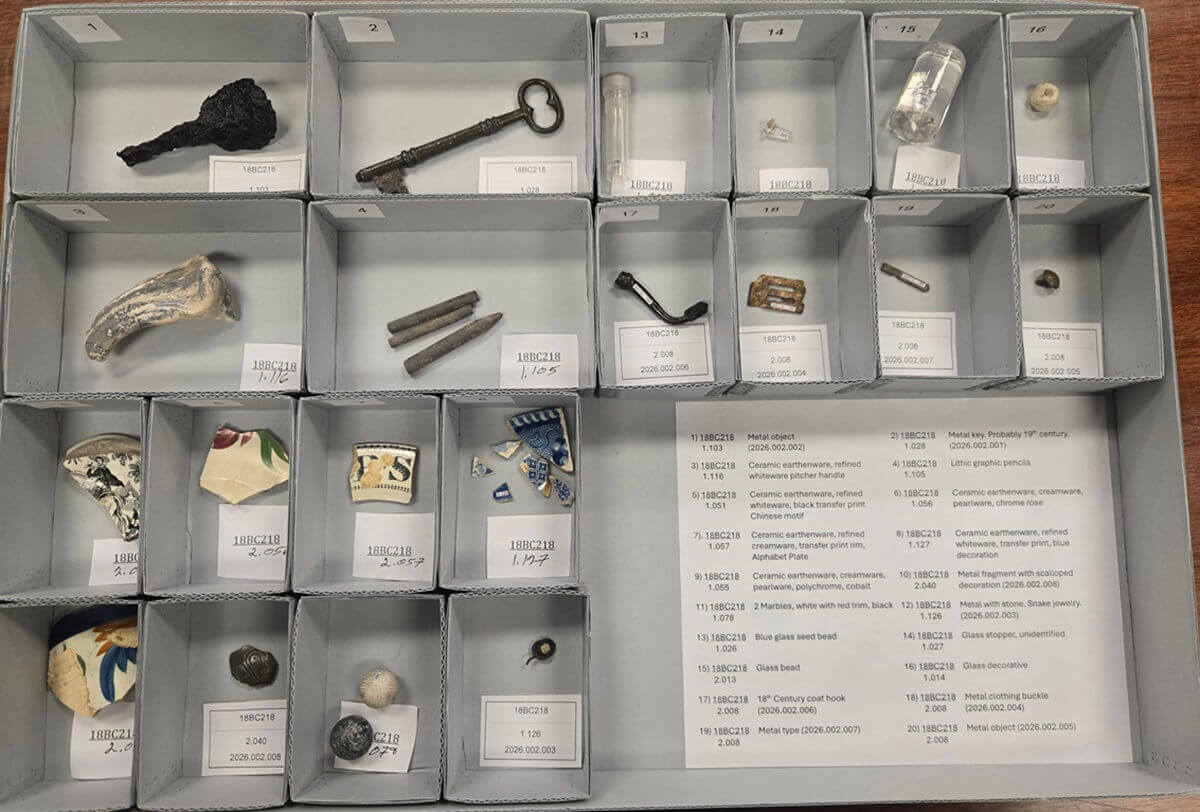
The Church of the United Brethren in Christ is one of the precursor denominations of The United Methodist Church, formed in 1968. This makes Otterbein a vital founding father of the current UMC. Pictured here are artifacts from an Archaeological Dig of Otterbein’s cabin in 2023, on loan from the State of Maryland to the Baltimore-Washington Conference of The UMC.
Rev. Dr. Bonnie McCubbin serves co-vocationally as the Director of Museums & Pilgrimage/Conference Archivist for the Baltimore-Washington Conference as well as the Pastor of Historic Old Otterbein UMC, Baltimore, MD. She is the President of the Historical Society of The UMC and the Vice President of the NEJ Commission on Archives and History. An award-winning historian and sought-after preacher and speaker, her latest book is I Love to Tell the Story: A Pilgrimage Towards Racial Justice in The United Methodist Church.
This story was published on June 22, 2026. The contact is Laura Buchanan.


