
The following story is a continuation of story posted in March.
In June 2020, the New York Annual Conference received one of the COVID-19 Rapid Response grants from Global Ministries, the denomination’s mission agency. It was used for food ministries, and because efforts reached immigrant and ethnic-minority communities, where the gaps in service were the greatest, Global Ministries tapped funding from the Human Relations Day Sunday offering for this work and a second grant.
In March, the Rev. Morais Quissico, pastor of St. Mark’s UMC in Brooklyn, was looking at a bleak forecast for the church’s 2020 income. No rentals, no offering plates, and he was concentrating energy on how to transition to online services. His wife, Fatima, had other matters on her mind.
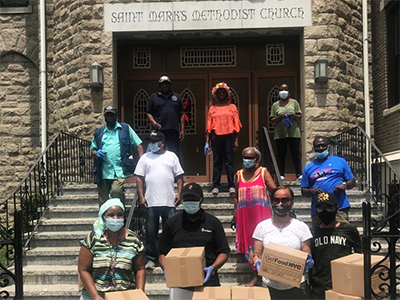
St. Mark’s is part of the Brooklyn cooperative parish started by the New York Conference last year. During their Thursday online meetings, the churches lend support and advice to one another. Rev. Sharon Cundy-Petgrave of the Bushwick parish UMC offered to provide food boxes and shared where and how they sourced food.
St. Mark’s also connected with Evangel Church on Long Island City, an Assemblies of God congregation. In a program called Nine Million Reasons, the church receives surplus food as well as farm-fresh produce from the federal government for distribution.
St. Mark’s is feeding up to 1,200 people a week. In November, the church’s pantry was approved by the city as an Emergency Food Assistance Program. The New York City Society supported the renovation of a space in the church for food storage.
St. Mark’s has a diverse congregation, with Caribbean, Asian, African American and African members. “All of the races we have in the city you’ll find in the food line, really, to our surprise,” noted Quissico.
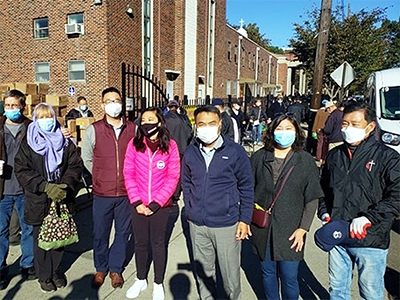
First United Methodist Church in Flushing, Queens, a predominantly Korean congregation with the Rev. Chongho James Kim as senior pastor, started outreach into the community by making a thousand cotton masks. Mina Yoo, the English language minister for the church, says that small act, distributing to senior home residences, nursing homes, and family shelters beyond the Korean community, sparked a good energy in the congregation.
Members decided to share whatever they could to help day laborers with no work – one family bringing 100 bags of rice and another 100 frozen chickens to distribute 100 bags of food one day a week. Those first weeks they distributed food to about 50 Korean families, but also to 100 mostly Hispanic families in the community. Later, an influx of Chinese families lengthened the line.
First UMC continues to serve 250-300 people each week and has applied for an Emergency Food Assistance Pantry with the city. In addition, the congregation is dreaming of future projects, like a food coop that will not only supply fresh food but also job training and nutritional education for the whole community.
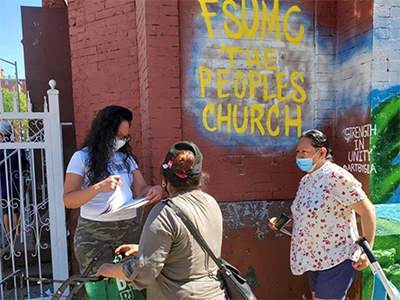
First Spanish UMC in East Harlem was at first concerned for its own. “We were just trying to serve these three or four elders, and we ended up getting food from WSCAH (West Side Campaign Against Hunger) over with St. Paul and St. Andrew in Manhattan,” said the Rev. Dorlimar Lebrón Malavé, the pastor.
Once the word got out that First Spanish, known in the community as “the people’s church,” had food, demand rose quickly. The congregation connected with the Church of the Village and then Evangel Church for food boxes. Today, First Spanish provides food for 400-450 households every week, or about 1200-1500 individuals.
The New York Conference aided the churches mentioned in this article and others, not just in New York City, but in rural districts of New York state and other cities across the conference.
excerpt from a story by Christie R. House, consultant, writer and editor, Global Ministries and UMCOR.
One of six churchwide Special Sundays with offerings of The United Methodist Church, Human Relations Day calls United Methodists to recognize the right of all God’s children in realizing their potential as human beings in relationship with one another. The special offering benefits neighborhood ministries through Community Developers, community advocacy through United Methodist Voluntary Services and work with at-risk teens through the Youth Offender Rehabilitation Program.
When you give generously on Human Relations Day Sunday, you encourage ordinary people to have a voice in changing the world. Give now.


