We’re all on a faith journey, but it’s easy to stray from the path. Staying close to God can be aided by what the Revs. Michael and Josh Kurtz call “guideposts.”
“These are things that have kept us on the path, kept us moving forward in faith,” Josh shares.
This father-and-son team brings their decades of pastoral insight and different generational perspectives together in the book Leading, Loving, and Living: Ten Guideposts for the Jesus-Following Journey.
“Here are ten guideposts, not the only ten… These are foundational, universal, time-tested disciplines and practices that we’ve seen, both ancient and modern, that people have benefited from, which we experience and base our life upon,” Michael explains.
Lead through three roles
“My simple definition of a leader is relationship with influence, hopefully positive influence. We’re all leaders in some way in the following of Christ,” shares Michael.
The threefold office of Jesus Christ, which was first gleaned from Old Testament Scriptures in the fourth century, suggests ways our leadership is a faith practice.
1. Share words of hope as a believer-prophet: “The prophet is called to share not his or her word, but to share a Word that's been given to the community, so it’s receiving a Word as well. The Word that we are sharing is the Word we’re accountable to. We’re set apart but not set above. We come alongside,” Michael says.
2. Serve others as a believer-priest: “We are comforting and praying for each other. We are hospitality team members, worship leaders, teachers. We serve one another with gifts that God has given us,” Michael continues. “And we are peacemakers. Not peace-lovers because it’s not about what appeases people.”
3. Support the community as believer-kings: “Think of this like a shepherd,” explains Michael. “These are God-given administrative gifts. They have to come with humility and peace. This is about serving the organization, for structure, safety, and security.”
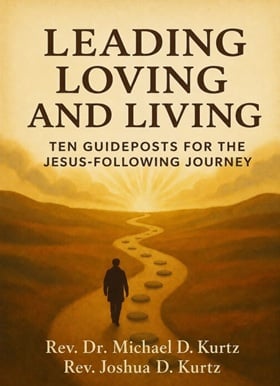
Leading, Loving, and Living: Ten Guideposts for the Jesus-following Journey was crafted to be a practical, rather than solely theological, resource. Individuals and small groups will find Scripture passages, prayers, interactive prompts, and reflection questions throughout.
“We hope that this is something you take alongside you for the journey and add to it, and that it would be a framework for us to find our way back to center to explore the riches and beauty of the God life,” says Josh.
Want to connect with one of the authors? Email Michael Kurtz.
Love through three rules
“In Micah 6:8, God speaks to the prophet Micah to do justice, to love mercy, and to walk humbly with God. Those are the requirements of the Lord. We noticed they parallel very nicely with the General Rules of the Methodist movement,” Josh mentions.
4. Do no harm: “This is an invitation for us to resist evil, injustice, and oppression in whatever forms they present themselves, which is a part of our baptismal vows. In Micah, justice is rooted in relationship. The action of doing justice must always be involved in community,” says Josh.
5. Do good: “Mercy is all about God’s covenantal, unending, faithful loving-kindness and love,” Josh explains. “God is with us no matter what and God is inviting you to be part of that love as well, so that you can truly do good and live into the good God life.”
6. Attend upon the ordinances of God (or, Stay in love with God): “William Barclay says, ‘Humility is the passport to the presence of God.’ We can enter into every conversation, situation, and area of our lives thinking, ‘I have something to learn here in this moment.’ Do as Jesus does, live as Jesus lives, love as Jesus loves,” Josh encourages. “We need God and we need those teachers amongst us that can help us deepen our relationship with God and one another.”
Live through four rubrics
The Wesleyan Quadrilateral are principal factors that John Wesley believed illuminate the core of the Christian faith for the believer.
7. Study Scripture: “Here is the guide for our tradition, reason, and experience. We do not want to make the Bible an idol above God instead of an active, living-letter Word. We affirm that the Bible we interpret is a love letter, not a rule book. There are some guides there, but it’s out of a love and a narrative and a relationship,” Michael mentions.
8. Reflect on tradition: “We think about the Great Commandment. We look at traditions and say, ‘Does this serve God? Does it love people?’ Then, ‘Is it necessary and life-giving to our community?’,” shares Michael. “I think there’s a heightened awareness of not just practicing things because they’ve been handed down, but let’s be open about it. Substance, not style.”
9. Practice reason: Michael remembers a seminary classroom with a poster of Jesus dying on the cross and a caption that said, “Jesus died to take away our sins, not our minds.” Michael says, “We continually seek to have our minds guided by Scripture, by the tradition, and an ongoing process of learning. We haven’t figured it all out. We’re in a process, on the path, and we keep learning and growing in community.”
10. Embrace experience: “We have certain paints on our palette, and we have the responsibility to use the paints we’ve been given to create. We’re co-creators [with God] in our experiences. We’re formed and shaped, and then we reflect upon the experiences, which are a God-given gift for us to grow,” Michael shares.
Our calling in divisive times
Following ancient guideposts that are relevant to our faith journey today propels us forward as we find new opportunities to share God’s love. Josh says, “I think we have a witness to the world as followers of Jesus in the Wesleyan way of salvation to offer Christ, and to be the church in really challenging, polarizing, divisive times.
“Jesus brought twelve [very different] people together – fishermen, a tax collector, a religious hothead zealot - and somehow, because of Jesus, they're on a mission. And what looked like a train wreck on paper actually led to transformation. And we get to inherit that.”
Laura Buchanan works for UMC.org at United Methodist Communications. Contact her by email.
This story was published on October 6, 2026.


