

Millions of Ukrainian children and teenagers have lost not only their homes, familiar schools, and friends due to the full-scale war, they’ve also lost their sense of future and stability. Weeks and months of forced relocations, occupation, or evacuation abroad are often accompanied by deep internal isolation.
Seventeen-year-old Polina knows this all too well. Tonight, for what she readily admits is the fourth time, she is once again gathering teenagers at Lighthouse for a screening of Twilight.
To an outsider, cueing up moody Pacific Northwest vampires for displaced Ukrainian teenagers might sound like pure escapism. To Polina, it is strategic theology. Once the credits roll, the room plunges straight into a lively, no-holds-barred debate dissecting Edward Cullen’s red flags, the anatomy of toxic relationships, and—with surprising ease—why every human soul aches for unconditional love that only God can actually pull off.
Later, when the room empties and the chatter dies down, she will walk back to the local United Methodist shelter—the makeshift refuge that quietly became her home two years ago when war scrambled her life. There, she’ll pack a bag for an upcoming trip across the Carpathian Mountains to Lviv, where she is studying at an institute for leadership and coaching. She wants to bring back sharper tools, better management skills, and a deeper grasp of leadership to pour straight back into the Lighthouse team.
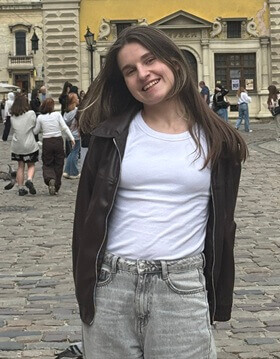
Polina during a trip to Lviv, where she studies leadership to bring back skills to the Lighthouse youth center.
Before arriving in western Ukraine, Polina had mastered the art of survival through low expectations. "When you move so many times, you simply learn not to have expectations," she says. Her family’s map is a blur of forced moves: Surviving Russian occupation in the Kyiv region, an urgent evacuation to Poland, and then a disorienting drift through several Ukrainian cities before finally landing at the United Methodist shelter in Uzhhorod. By the time they unpacked in Uzhhorod—their fifth relocation—Polina felt like a ghost drifting through an unfamiliar town, completely detached from the life she once knew.
None of her future opportunities—the leadership courses and the sanctuary she now leads—were obvious back then. But right now, high-level theology and leadership frameworks will have to wait. The first teenagers are due to burst through the door in fifteen minutes, the air outside is getting crisp, and somebody urgently needs to heat up the cocoa.
A different kind of teenage tears
For Polina, like thousands of other Ukrainian teenagers, the hardest part of her struggle wasn't just losing a room or changing schools. It was the sudden inability to see ahead.
"Being a teenager in peacetime is hard enough—even just figuring out what you want to do after graduation," Polina says. "When you can't plan your life anymore, all of that gets so much heavier. And our parents don’t entirely get it, because their teenage years happened in peace."
The result was an exhausting, quiet isolation. "You’re constantly afraid people won’t understand you," she explains. "You become afraid to talk."
That gap is what Lighthouse, a youth ministry founded by The United Methodist Church in Uzhhorod, can fill. It opened its doors not as a project with stiff programs, but as a space where displaced youth could unpack the weight they were carrying, find community, and see faith modeled through real, daily support.
"They had physical safety, but emotional anxiety remained very high," explains Anastasiia, Lighthouse administrator.
The double disruption of COVID-19 remote schooling followed by the full-scale invasion made socialization unusually difficult for an entire age group. Worse, many displaced teens struggled to fit into local peer groups in western Ukraine.
To offer a place where they would be welcomed, loved, and heard, the team opened Lighthouse on September 27, 2025. Set up as an open community center operating six days a week, it quickly grew. Today, roughly thirty to forty teenagers drop in daily for board games, art workshops, and casual conversation, with larger events drawing up to sixty people.
Learn more and get involved
The ripple effect of discipleship is at the heart of why the youth ministry center in Uzhhorod, Ukraine, is called Lighthouse.
"The idea is for people to come here, absorb the light, and then carry it out into the world," Anastasiia explains. She describes their ministry model as heromakers—investing directly in young people so they can grow into the leaders who will rebuild Ukraine’s future.
The trust built over the center’s first year of ministry has also opened spiritual doors. Following casual Bible studies and a summer youth camp, around ten teenagers who had never previously explored faith or attended a church began coming to Sunday services on their own.
The work of centers like Lighthouse, youth ministries such as Youth for Jesus, and the shelters run by The United Methodist Church continues thanks to the kindness of people around the world.
You can support these initiatives through prayer, spreading the word, or financial contributions via In Mission Together—an initiative of United Methodist Global Ministries that connects congregations and groups with The United Methodist Church in Ukraine and the issues it faces. Your support ensures that Ukrainian youth continue to receive not only a roof over their heads, but a light of hope.
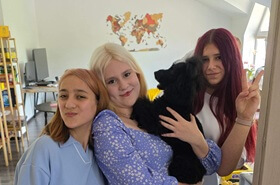
Above: Students gather at Lighthouse for community and connection. Photo courtesy of Lighthouse Youth Ministry
A room with strangers
Safety for Polina’s family arrived quietly through word of mouth. Her mother learned about a shelter run by the local United Methodist church, offering the family a stable roof after months of drifting. They have lived there for two years now.
"Living with random people can be hard at times," Polina says. "But everyone here is displaced. There is this unspoken understanding that the person next to you has walked through the exact same things."
It was the other teenage girls living down the hall who first took her to Lighthouse. "They showed me around, explained how everything worked," she recalls. "It was the first place that felt warm and easy."
On the rug
Connection started simply, with weekly girls' gatherings they called "on the rug."
"I suddenly felt an environment where people treated me kindly," Polina says. "It felt like finding a second home."
Her family was not religious, and church seemed distant. The turning point came in the summer of 2026 at a youth camp named Relationship, run with the help of visiting missionaries from across the United States. There, Polina repented and gave her life to God.
"God was always trying to reach me in small steps, and there it finally clicked," she explains. "Church stopped being a far-away ritual. It became something close, simple, and a place where you are actually heard."
Empathy brings relationship
Being cared for created an immediate, instinctive urge to return the favor.
"I always had this feeling that I couldn't just remain a passive visitor," Polina says. "When people pour so much good into your life, you naturally want to give something good back."
Anastasiia, who first knew Polina as a quiet resident in the church shelter, watched the shift happen in real time.
"Once Polina started coming around Lighthouse, her leadership instincts woke up," Anastasiia recalls. "It showed in her initiative. She didn't want to just be a consumer or a spectator—she wanted to be a doer."
That proactive spark was what brought about the Twilight movie nights in the first place—Polina’s own idea to help quiet newcomers settle in and start talking.
At 17, Polina is very much a teenager herself, living through the exact same upheaval as the kids walking through the doors. She knows the weight firsthand.
"I know what it feels like—the constant instability, the fear of running into bullies, that sinking feeling that nobody will understand where you’re coming from," she explains. "My goal became very simple: to just be the friend I needed so badly back then. When teenagers aren't afraid to walk up to you, hug you, and just hang out—that's when you feel truly useful. It leaves this quiet, deep warmth inside."
An open door
Asked what she wants people outside Ukraine to understand most, Polina keeps it direct and grounded.
"Keep staying close," she urges. "For displaced families like mine, material help is vital to feel secure and safe. But what matters just as much is having people who actually listen to our needs, who keep the contact alive, and who keep their hearts open to each other and to God. Don’t stop showing up."
It sounds remarkably mature for a 17-year-old, but hardly surprising—war has a way of stripping away childhood fast.
Right on cue, the front door bangs open, letting in a gust of cold air, wet sneakers, and familiar chatter. Polina glances at the stove where the cocoa is steaming, then looks over at Anastasiia and the rest of the team as they step forward together to greet the newcomers—there will be plenty of time tonight to unpack big questions, laugh over Edward Cullen, and listen to whatever hurts, but for now, the room is warm, and nobody who steps inside has to feel like a stranger.
Karolina Havrylenko is a freelance journalist and student based in Lviv, Ukraine
This story was published on November 4, 2026. The contact is Laura Buchanan.


