
What began as simple English-speaking clubs a quarter-century ago has become living proof of how God draws people together in their differences. Inside a student center in the city of Lviv in western Ukraine, displaced youth, lifelong locals, devout believers, and honest skeptics gather every Thursday to share a meal, ask hard questions, and discover that unity in Christ runs far deeper than denominations and war.
Making disciples, transforming the world
Youth to Jesus didn’t start with a polished ministry plan. It began with a burning desire of a Minnesota missionary couple to draw post-Soviet youth to Jesus over informal English chats, tea, and cookies in their rented apartment.
Each week, Fred and Stacy Vanderwerf welcomed local students into their home, where casual conversations quietly paved the way for Bible studies.That momentum grew in 2008 through summer camps run by Texans David and Shannon Goran.
But the story didn’t stay in that apartment for long. What had started as casual English conversations over tea and cookies was slowly becoming a spiritual community. Students kept coming back – first for the language practice and friendships, then for Bible studies and conversations about Jesus. And as the Gospel took deeper root, some began to repent and turn to Christ. Soon, it became clear that this growing community needed more than a place to meet. It needed a church.
In 2010, the ministry moved into a larger apartment, which the team renovated to accommodate the growing group. That move marked a turning point: Saint John’s United Methodist Church was officially established.
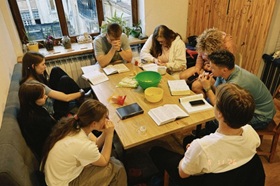
The speaking clubs had grown into something no one could have fully planned at the beginning – a church where young people could worship together, grow in their faith, and find a spiritual home.
The story continued to unfold. By 2012, Ukrainian pastor Volodymyr Prokip stepped up to lead alongside Pennsylvania missionary Michael Eyregood, carrying the young community into its next chapter.
From English lessons to shelter
As the needs of young people shifted, the ministry adapted. It weathered the economic strains of the early 2000s, the onset of Russia's attack on Ukraine in 2014, and the full-scale invasion launched in February 2022, which displaced millions and caused widespread destruction nationwide.
Prokip remembers, “On the second day of the full-scale war, we opened our doors to host people who were fleeing for their lives as their hometowns fell under Russian occupation or became too dangerous to survive in. The study hall was suddenly divided in half, filled with bags of humanitarian aid.
“Every single day, exhausted people arrived looking for a place to hide. In the background, the washing machine ran non-stop as we scrambled to have clean sheets ready for the next family coming through the door of our church.”
A place to stay, a reason to believe
For Katia, an internally displaced youth from the Kherson region, the war upended daily life. During the conflict, she lived inside the church community for two-and-a-half years. While staying at the ministry’s facilities, Katia watched both the regulars and newcomers in the community.
“Everyone was different and had their quirks, but they all just wanted love and acceptance,” Katia recalls. “Over time, my heart changed. I wanted to be like the people I saw serving the Lord – to love others, serve them, and honor God through it.”
That shared pursuit made denominational differences fade into the background around the table. “It never felt strange to study the Bible with people from different denominations,” she says. “We all had open questions, and we looked for answers in Scripture. We might come from different traditions, speak differently, or carry different mindsets, but through His Word, God unites us all.”
Unity under pressure
War turned life upside down, but Thursday nights remained untouched. At 7 p.m., the doors open, and people from all walks of life and church traditions trickle in. For Diana, a Greek Catholic who visits the gatherings, it felt like home, even from her first gathering.
“I think there is a lot that we have in common, even though in many ways we are different,” she says. “But it is not really about what is similar or what is different. It is that everyone wants to move toward Christ.”
For Diana, interdenominational unity is grounded in direct experience. Her hometown of Melitopol was occupied by Russian forces early in the invasion. Following Russian bans on Protestant congregations, Protestant believers began covertly attending Greek Catholic services – finding common ground across distinct traditions.
“One body of Christ, simply with different expressions of love for him,” Diana says.
Room for questions
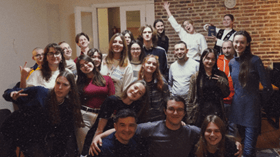
Those who come to Youth to Jesus are not searching for religiosity, nor are they looking to be told how to live. People are hungry for God, and that hunger reveals itself in lively discussions, raw and honest questions, and the joy and warmth that fill their hearts.
Prokip views this broad access as central to the group's mission. He says, “We believe in the Great Commission of Christ: ‘Go and make disciples of all nations. We are not building a Methodist church. We are building the Kingdom of God.”
For Prokip, success isn’t about counting new church members. It is about watching people discover faith, step into leadership, and go on to serve their communities—wherever life takes them.
Nobody has to leave their traditions at the door. Orthodox stay Orthodox, Catholics remain Catholic, and United Methodists are still United Methodists, while anyone wrestling with doubt is free to simply seek without being forced into a label.
The differences are real, but they never get in the way of sharing a meal.
Russia’s full-scale invasion shattered daily life for millions across Ukraine, upending homes and futures. Yet every Thursday evening in Lviv, young people still pull up a chair. They dive into Scripture, serve God, argue, laugh, pass around food, and pray together around the very same table.
Karolina Havrylenko is a freelance journalist and student based in Lviv, Ukraine
This story was published on October 7, 2026. The contact is Laura Buchanan.


