“Within this life, there's never a point where we'll say, ‘I've got it all figured out. I know what this life of faith is about.’ There's always something new to discover and consider,” observes Rachel Hagewood, senior development editor at Upper Room Books.
Prayer and Bible study are key spiritual practices that urge us forward on our lifelong journey of faith. If you need encouragement to strengthen these habits, The Upper Room Disciplines can help. The devotional book has been published annually since 1959 and includes daily meditations that follow the Revised Common Lectionary cycle.
What is the Revised Common Lectionary?
A lectionary is a listing of readings from the Bible to be used on particular Sundays or days of the Christian Year. The early church created the Christian Year so the whole message of God's saving work in Jesus Christ would be heard throughout the year. Readings are on a three-year cycle – an A, B, and C year.
The first Methodist churches in the United States were given a lectionary to use by John Wesley, based on the one-year lectionary found in the 1662 Book of Common Prayer of the Church of England.
By using the Revised Common Lectionary, United Methodists share the Scriptures read each Sunday with other Christians. These Scriptures support the Christian Year, the church's underlying plan for inviting, forming, and sending disciples of Jesus Christ into the world.
Updates were made to the Revised Common Lectionary in the Spring of 2025 to address anti-Jewish bias in certain readings. The Upper Room Disciplines will begin to follow this revised cycle in its 2028 edition.
Learn more: Why do United Methodists use the Revised Common Lectionary?
Engage in daily practices
The Disciplines are designed to awaken readers’ hearts and minds to God’s wisdom. Each day, readers will engage in a Scripture passage, reflection, and prayer, but before they begin, they are encouraged to light a candle.
“Often the action of lighting a candle, having a scent, or having some other sensory piece, gives us the opportunity to shift into a different space from our ordinary life, where we can focus on new ideas or understandings,” says Hagewood.
Revisit Scripture as you grow and change
“As people of faith, we’re traveling along this journey that's almost in a spiral format,” offers Hagewood. “We come back to the same Scripture, but we're at a different point in our lives. We've had different experiences.
“The Scriptures themselves don't change, but we come as different people. And I think that's one of the beautiful things about the lectionary, this three-year cycle that is intended to give us an overview of all of Scripture. It gives us an opportunity to bring newness to the same Scriptures and learn them in a different way.”
Many local churches use the Revised Common Lectionary as their guide for worship and planning each year, and the Disciplines can be a companion. Individuals and small groups will be led deeper into the weekly set of Scripture passages, aided by an accompanying study outline and questions.
Be inspired by writers from around the world
Clergy and laypeople from across the globe contribute to the Disciplines. They are selected with intention, ensuring a wide diversity of theological backgrounds, perspectives, and life experiences.
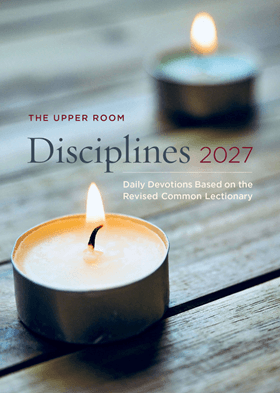
Contributors for the 2027 edition include Bishop Ken Carter, Bishop Cynthia Fierro Harvey, Willie James Jennings, Grace Ji-Sun Kim, Bishop Jeffrey Leath, Lyn Pace, Joerg Rieger, Chanequa Walker-Barnes, and many more.
The publication is available in standard and large print formats, as well as digital editions in English and Spanish. It is published by Upper Room Books, a ministry of The UMC’s Discipleship Ministries.
Hagewood explains, “People are going to encounter a variety of voices of people they might recognize or they’ve never heard of. With fifty-two weeks, we can bring in a lot of different people and ideas.”
Each contributor is responsible for one week of the Disciplines, including the reflections, the week’s theme, and the small group resources. Everything is rooted in the Revised Common Lectionary’s Psalm, Gospel, Old Testament, and New Testament passages.
“It’s a helpful way of looking at Scripture more holistically. So often, we engage in Scripture, particularly within the context of a worship service, where we'll look at one passage,” mentions Hagewood. “We find so much more depth when we're able to look at it as, ‘Where is that Scripture in the context of the broader story? What's coming before? What's coming after?’
“Jesus, Paul, and all of the writers in the Bible were steeped in the Hebrew scriptural tradition. When they call back to those, for us to be able to go back to those as well and steep ourselves in that tradition gives us the opportunity to add more depth to what they're saying to us and also pull in more depth from the religious tradition that we’re living in.”
Feel a nudge
“The Disciplines and The Upper Room Devotional invite a daily practice of small nudges and transformation. It doesn't have to be big,” encourages Hagewood. “All it has to do is just open a little more space each day for something new, something different, an opportunity for just a little bit of growth.
“A lot of times the world – our culture – expects big things, big changes. We, as people of faith, can really be influenced by that. I think it's more formational for it to just be consistent and small, and there's beauty in that.”
Laura Buchanan works for UMC.org at United Methodist Communications. Contact her by email.
This story was published on September 9, 2026.


