
A series of tropical storms, flash floods, and other disasters hit the Philippines over the past year. Communities have suffered, but United Methodists have been present throughout the relief and recovery efforts.
First, an earthquake…then, a typhoon…
The onslaught began on September 30, 2025, when a magnitude 6.9 earthquake, with its epicenter in Bogo City, struck the province of Cebu, leaving thousands of families displaced[1]. In early November, Typhoon Tino swept through the same area, damaging more communities and displacing more families.
The unprecedented destruction of properties and heavy flooding across Cebu led to dozens of missing people, with hundreds remaining in evacuation centers even a month after the consecutive disasters.
At least 14 communities, hundreds of families, and thousands of individuals were supported in their time of need by the Davao Episcopal Area-Disaster Management Office-United Methodist Committee on Relief (DEA-DMO-UMCOR), which completed its rollout of relief and recovery efforts in the province in August 2026.
Assistance included food packs, hygiene kits, shelter items, and more, depending on each area's needs. Water access was also part of the relief efforts in two communities that struggled to secure consistent clean water sources.
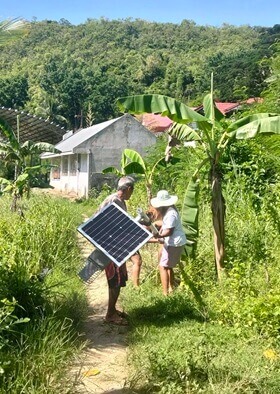
Solar lights are installed in storm-ravaged areas of the Philippines after consecutive disasters led to a multi-faceted relief effort in 2025 and 2026.
Through two intervention programs, five communities across four municipalities and one city received solar lighting installations, including 24 streetlights, a flood lamp for a communal well, and three tube lights.
Then, a tropical storm
In February 2026, 34 provinces and eight cities were affected by Tropical Storm Basyang.
The DEA-DMO-UMCOR responded by visiting several affected areas and providing food packs and hygiene kits to 300 families in the municipality of Bayabas.
During the disaster, one resident recounted how the floodwater had risen to waist-deep levels even on the second floor of buildings. They expressed gratitude for the assistance extended to their community. Mami Dc Diaries shared, “More than the material support, what truly moved us was feeling seen, remembered, and included. Most of all, we felt God’s love through generous hearts.”
To bring light to disaster-affected communities and provide safer spaces for an additional 300 families, nine solar lights were installed throughout the United Methodist Development Academy, community areas, and the shared space of First UMC, Iligan City.
The UMC offers steadfast support
As the multiple interventions of the DEA-DMO-UMCOR concluded, Bishop Israel Painit, of the Davao Episcopal Area, said, “The main motivation that drives the entire team, including those who support UMCOR, is the belief and commitment to share God’s love with those who are in need and to save lives.”
A dedication ceremony was held for the renewable energy facilities. Painit emphasized that loving boldly means showing mercy. Drawing from the experience of darkness brought by disasters in the community, Painit reminded people that their faith, like a light, cannot be hidden even in times of darkness.
Dan Ela, DEA Disaster Management Coordinator, reflected, “A common theme during the dedications was the significance of bringing light to dark places and that darkness never overcomes the light… Providing proper lighting improves safety and security, and helps prevent sexual exploitation, abuse, and harassment, especially of children and women.”
The UMC continually affirms its mission to stand with people through times of crisis and recovery and commits to remaining a vital part of ongoing disaster response and recovery efforts in communities affected by recent disasters.
Larren Jo Basillo and Jhoanna Kylle Ragasa work for United Methodist Communications and UMC TV in the Philippines.
This story was published on September 21, 2026. The contact is Laura Buchanan.
[1] Displacement Tracking Matrix (DTM), conducted with the Department of Social Welfare and Development (DSWD) on October 7–8, 2025


