“Lord, when did we see you hungry and feed you, or thirsty and give you something to drink?” … “Truly I tell you, whatever you did for one of the least of these … you did for me.” – Matthew 25:37, 40
In these familiar Bible verses, Jesus challenges us to look outside of ourselves, invest in the needs of those around us and transform lives. While the concept resonates with us, putting it into action can be difficult.
Guidance is offered by The Rev. Elizabeth Mae Magill, church planter, leader in creative ministry and advocate for the unhoused. Her latest book, When Did We See You?, encourages us to evaluate our “stuff” and consider how our material privilege shapes our relationship with God and neighbor.
“I don’t think any one person can tell another person what is the correct, Christian answer for them, but I do think that together we can have a conversation about this uncomfortable topic and come to different conclusions than we’ve been coming to before,” Magill says.
Be honest about wealth
Even in today’s context of rising costs of living and unknowns about the future, many of us have plenty of resources. Yet, Magill points out, “None of us say that we are wealthy…we view the wealthy as someone else. That affects how we read Scripture and interpret Jesus’ comments.
“People who have wealth have food, housing, clothing, some safety net and can do some fun things. Anything beyond that might be excess. Think about how that excess can be something that makes a difference in your community.
“When we’re asking the questions of how to serve the community or what to do with our wealth, [the needs and people] we have around us are Jesus. Do we want to be helping Jesus? That’s always the question.”
About the book
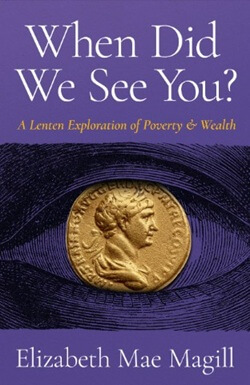
When Did We See You?, available from Upper Room Books, offers an opportunity to take inventory of our wealth and consider how we can use our possessions to make the world a better place. It includes information about what it means to be in the middle class, why it is okay to have wealth and the meaning of spiritual wealth.
Since wealth and our relationship to it is personally unique given our life situation and countless other factors, the book poses many questions and leaves space for contemplation. The weekly devotionals and daily reflections are best processed through conversation, either with loved ones or a small group, which can be guided by the included discussion questions.
“[My passion] is to help people figure out how to do church in ways that are really connected to the community they’re serving… My dream is that people will read the book and take away one thing and say, ‘Oh, I am going to do that differently,’” Magill shares.
Do something different
“The book talks about charity, in respect to what we can give away in terms of dollars and ‘stuff,’ but also in terms of systems change and how we can use what we have to help with that,” Magill shares.
Putting wealth into action can look like these examples:
- Because of the things they learned as Magill wrote the book, she and her husband updated their will to ensure their estate would go to organizations that work to even out the disparity of generational wealth, a type of financial security that is less prevalent in minority groups.
- Cohorts of churches are banding together and using their congregational wealth to end high-interest payday lending practices. Instead, they offer interest-free loans with flexible payment plans to people who need short-term funds.
Take time to reflect during Lent
Many Christians will fast during Lent, avoiding everything from sugary treats to scrolling on social media. While these sacrificial practices can be meaningful, they can sometimes be focused on the self rather than others.
Magill says, “I see in this that we are realizing that our ‘stuff’ gets between us and God, and I think we can be more explicit about seeing that.”
In the early Church, Lent was a time for charity, investing in the community and fulfilling the needs of neighbors, something that Magill learned recently from Andrew McGowan in his book Ancient Christian Worship.
This practice is certainly something we can adopt today. Taking time during Lent to deeply reflect on how we live our lives, spend money and share with others can be a transformational experience that extends far beyond a season of the year.
Laura Buchanan works for UMC.org at United Methodist Communications. Contact her by email.
This story was published on January 22, 2026.


