
Church and Community Workers (CCWs), United Methodist missionaries serving throughout the U.S., connect the church with underserved communities, leading programs that drive positive change.
CCWs come from a wide variety of backgrounds, training, and life experiences. Here are a few of their stories:
Explore becoming a Church and Community Worker
Emerging ministries, evolving needs, and retirements are all factors that encourage persons discerning God’s call to consider a vocation as a CCW.
Those interested in learning more are encouraged to visit the General Board of Global Ministries website to find an overview of the program, expectations, and the application process.
Becoming a CCW, from initial interest through application, discernment, interview, training, hiring, and deployment, can take six months to a year. Email [email protected] to ask questions and to learn about open CCW positions.
Support the program
Donate financially to support the connectional work of CCWs by making a gift through the Advance.
Randy Hildebrant: Following a call to serve
“Our work seeks to love like Jesus at the places of community need,” says Randy Hildebrant, CCW and director of God’s Country Community Ministries in Michigan. He has also served in Appalachia and in Nebraska.
“I am not ordained or subject to a bishop’s appointment. I don’t baptize, administer the sacraments, or lead a local church. I am commissioned for my service by The United Methodist Church.
“Some people have likened what I do to social work,” he shares. “My work definitely addresses great social needs in our communities. I help our partnering ministries and many volunteers in ‘doing’ the love of Jesus out in the communities we serve.”
God’s Country Community Ministries addresses rural poverty and spiritual needs across five counties. The organization was founded in the 1970s as a collaborative effort among seven United Methodist congregations yearning to meet their community’s needs through shared resources. The ministry expanded in 2024 to include ministry with and for all, regardless of denomination.
“We run feeding programs for children and the poor. We provide showers, laundry service, and shelter for the homeless. We have a free clothing store and work with area school systems to address identified needs for children,” explains Hildebrant.
A big part of Hildebrant’s job is managing Volunteers in Mission (VIM) teams who come to help.
“We host around 17 mission teams each year, composed of able-bodied youth and adults from churches and other organizations across the country to assist with work projects, primarily helping with needed home repairs for impoverished residents,” he says. “Last year’s work included replacing a badly leaking roof on the home of a senior couple who were also dealing with a terminal cancer diagnosis.”
Katie Peterson: Life as a CCW and a Deaconess
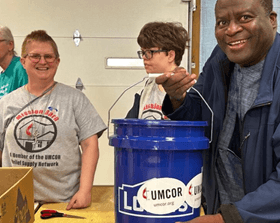
Church and Community Worker Katie Peterson (left) and members of her team at the Mission Barn prepare emergency supplies for an UMCOR disaster response. Photo courtesy of Katie Peterson and the Michigan Conference.
“Church and Community Workers are deployed by Global Ministries and must be willing to move around the United States every three to nine years to serve ministries beyond their home conference where their skills are needed,” mentions Katie Peterson, who serves as director of the Mission Barn in New Castle, Pennsylvania.
Peterson has served as a CCW in ministries in Tennessee, North Dakota, and Michigan. She is also a commissioned Deaconess, a committed public service ministry of The United Methodist Church, where her training and commissioning come from United Women in Faith.
The Mission Barn is a vital ministry that collects and distributes emergency supplies on behalf of the United Methodist Committee on Relief (UMCOR) to areas affected by natural disasters across the U.S.
Peterson also supports the life-assisting ministry of building accessible ramps for area residents who have difficulty entering their homes.
Margaret Madison: Lessons in trust and leadership
Amid wrestling with her personal direction, Margaret Madison learned about the CCW program and chose to pursue a path dedicated to helping people beyond church walls.
She journeyed into a future that helped her learn and develop new skills that made a difference in the lives of others. Now retired, she continues to value the lessons in trust and leadership she learned from God through her work.
One of Madison’s first assignments as a CCW was to God’s Country Community Ministries. Madison learned that Michigan winters are cold and hard, but the people are gracious. She has fond memories of people discovering the joy of sharing their hospitality and gifts in collaboration to help meet needs.
After 11 years in Michigan, Madison spent 16 years working with Community Development for All People in Ohio, where she was part of a team that launched a life-transforming housing ministry in partnership with Habitat for Humanity. The organization also operates a free store, a fresh market, community gardens, a youth development program, a leadership program, and other social enterprises.
This story is a condensed reprint of an article from the Michigan Conference of The UMC. A more detailed version of this story is available on their website.
Glenn M. Wagner works for the Michigan Conference. Laura Buchanan works for UMC.org at United Methodist Communications. Contact her by email.
This story was published on May 22, 2026.


