

In eastern Democratic Republic of the Congo, persistent insecurity due to ongoing armed conflict has forced tens of thousands of people to flee their villages in search of refuge in safer areas — particularly in Goma, North Kivu and neighboring provinces, such as Maniema.
Working alongside local United Methodist organizations, the United Methodist Committee on Relief (UMCOR) provides displaced people and affected communities with practical assistance that restores dignity to each person, including food, psychosocial support, hygiene, and sanitation.
Supporting displaced people ‘an expression of faith’
For Jean Tshomba, coordinator of UMCOR’s Disaster Management Office in eastern Congo, commitment is nothing new.
Established in 2018, the office collaborates with district superintendents and pastors to ensure that the church community is fully involved in project implementation. In Goma, church leaders and volunteers help identify the most vulnerable households, and volunteers sort and distribute food supplies.
Reaching the displaced is challenging due to growing insecurity and the impassability of the roads. Where roads are cut off or dangerous, collaboration between the Disaster Management Office, district superintendents and local pastors becomes more valuable when coordinating aid.
For Tshomba, this work is an expression of faith. He said, “The church must fulfill its evangelical mission among vulnerable people, in accordance with the call of Jesus Christ."
Tshomba is clear that food is the top priority. Health, shelter, psychosocial support, and education come next.
A recent example can be seen in Goma, where UMCOR is providing food assistance to 300 vulnerable families for six months. Each month, they receive a kit containing rice, cornmeal, beans, vegetable oil and salt.
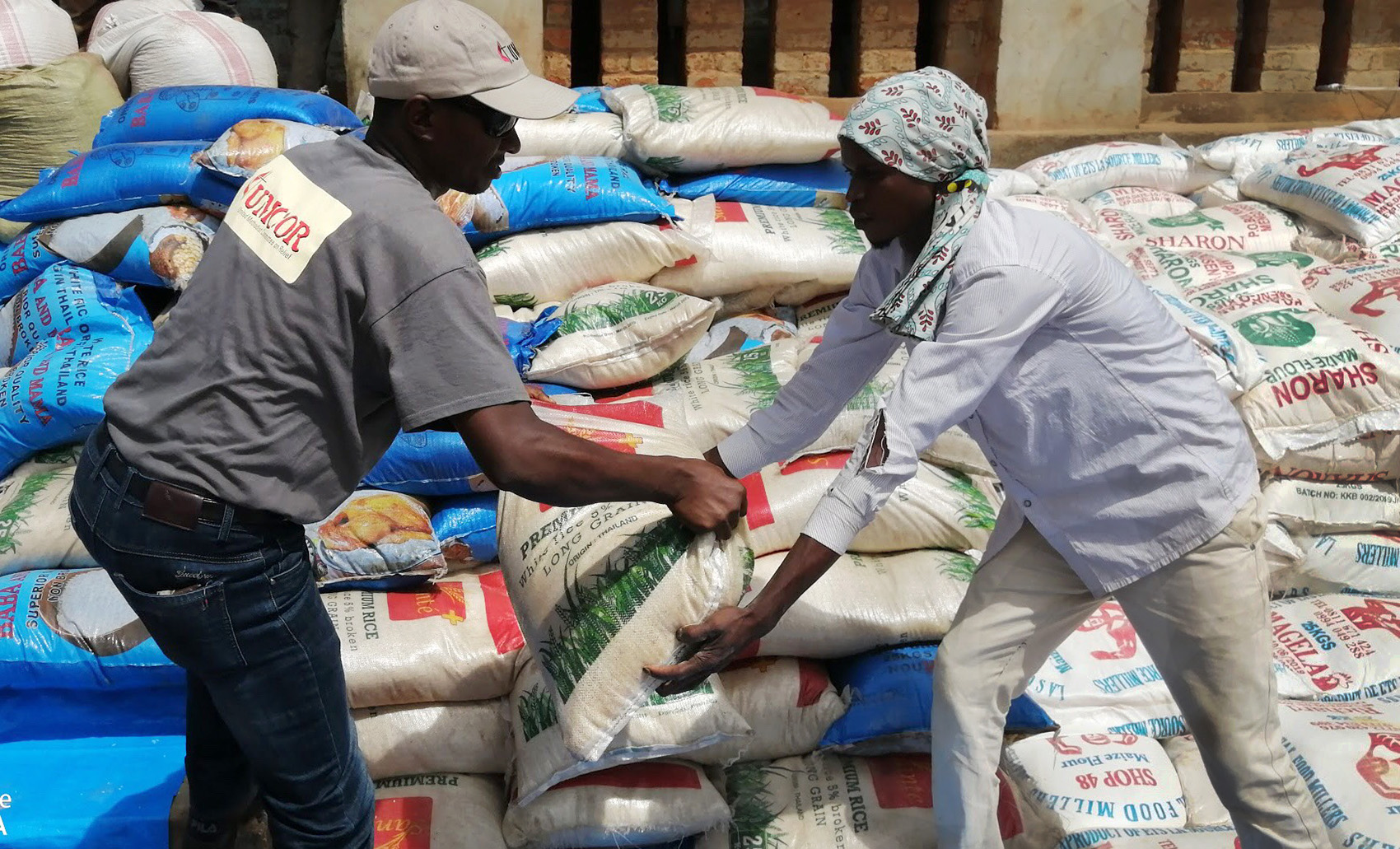
The faces behind the aid
When Bahati Innocent returned to Goma after being displaced, he picked up the UMCOR kit for his wife, who was hospitalized. He said, “I’m happy because when she comes home, she’ll find enough to feed the family."
At the church-run orphanage in Goma, where 22 children also receive these food kits, caregiver Marie Otchinga described the same challenge: “With the war, feeding 22 children had become practically impossible.”
Olive Bushu, a mother of six children displaced by the war, lives in a room at the local United Methodist church in Amani. She received assistance from UMCOR in 2025 after fleeing her village to seek refuge in Goma while the city was occupied by M23 rebels.
“I thank the church for its hospitality, because I didn’t know where to go with my six children, and today I received food assistance,” she shared. “I’m at a loss for words.”
This spirit of hospitality is also being passed on. During the June 2025 distribution in Goma and Bukavu, which was funded by two $10,000 UMCOR solidarity grants, the Rev. Esther Furaha Kachiko, superintendent of the Bukavu District, invited the recipients to pass on the generosity they had received.
“Let us, too, share our love for others by giving the little we have received from the church,” she said.
Serving where people feel forgotten
Those coordinating the aid describe it in the same terms as those receiving it: with relief, joy and a duty to help one another.
During the June 2025 distribution in Goma and Bukavu, Jean Claude Lumbadisha, a lay leader in the Goma district, said, “I don’t know how to express my joy today, because I’ve gone more than three days without eating.”
After a September 2026 fire in Bukavu, the Rev. Henock Musehura, pastor of the United Methodist Church in Ibanda, asked members from other neighborhoods to take in families affected by the disaster. He said, “We must help one another as long as we are alive."
In Tanganyika, Bishop Nelson Kalombo Ngoy visited camps for displaced people near Kalemie at Christmas, where the church had just distributed aid. He encouraged, "Ministry is not limited to the pulpit, but is lived out where people feel forgotten, voiceless and broken."
During a January 2025 aid distribution, Bishop Gabriel Yemba Unda, who was then resident bishop of Eastern Congo, said, “We are all called to be the hands and feet of Christ on earth.”
In Kibumba, North Kivu, where UMCOR had 24 rainwater cisterns installed in 2026, the mosque’s imam, Mulemeri Pilipili Luboho, praised a gesture that transcends denominational boundaries: “We thank The United Methodist Church for this gesture that respects and serves everyone.”
Improving hygiene restores dignity
Aid is not limited to food. In September 2026, thanks to UMCOR’s support and Bishop Antoine Kalema Tambwe’s advocacy, The United Methodist Church carried out two hygiene and sanitation projects in Goma.
Modern latrines were built at the Kituku market and at the Volcan charter school, with six stalls for women, six for men, and a shower. To ensure the longevity of these facilities, a management committee was established at each site, along with a cleaning kit.
“Before, we women suffered a great deal,” said a vendor at the Kituku market. “Today, with these latrines, we have regained our dignity.”
Mr. Bushu, principal of Volcan School, notes a tangible change: “Our students, especially the girls, were missing school because there were no latrines. Now, hygiene has improved and school attendance has increased.”
Two handwashing stations with soap were also installed at the bus station, where thousands of people pass through every day. One bus driver expressed his gratitude, saying, “We eat with our hands after handling money all day. These handwashing stations installed here protect us and our passengers.”
Serving with joy
A food kit does not end the war but it gives a family enough to eat, a father the means to reassure his wife, and a community a reason to hope.
This is the very essence of “Serving Joyfully,” a joy that does not deny suffering, but meets it with concrete actions — from both those who give and those who receive.
To support aid for displaced families in eastern Congo, donations can be made to UMCOR’s International Disaster Response Advance Fund #982450.
Chadrack Tambwe Londe is the French-language content coordinator for Africa at United Methodist Communications.
The page was published on November 16, 2026. The contact is Laura Buchanan.


