

For schoolchildren in South Sudan, a recent gift of exercise books, pens, school bags, and personal hygiene supplies are more than basic essentials. They are a reminder that their education matters, their dignity deserves protection, and their community has not forgotten them.
Through a $2,000 grant from the Holston Foundation, The United Methodist Church in South Sudan was able to support fifty children aged three to thirteen in the Koboko District. The donations ease the burden for families who struggle to provide basic educational necessities.
An interfaith effort
The Change for Children initiative led the effort. Beyond distributing supplies, it brings Christian denominations, Muslim communities, and other stakeholders together around a shared responsibility: Giving vulnerable children a better future.
Bishop Daniel Wandabula, Resident Bishop of the East Africa Episcopal Area, expressed gratitude to the Holston Foundation, describing the grant as an investment in children’s well-being. He said, “[The] impact is significant. For vulnerable children, these essential items communicate that they are valued and that their future matters.”
He emphasized that the initiative reflects the church’s mission to demonstrate God’s love. He encouraged, “Our faith calls us not only to preach the Gospel but also to demonstrate God’s love through practical acts of compassion and service.”
The bishop particularly welcomed the participation of Catholic and Anglican churches, Born Again Christian communities, Muslims and other stakeholders, pointing out that the initiative demonstrated that caring for children transcends religious differences.
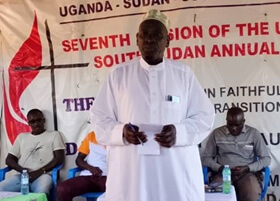
Abu-Bakr Way Lozo, a Muslim leader and guest of honor, addresses parents during the distribution of school supplies at Koboko United Methodist Church in Koboko District, South Sudan, highlighting the importance of supporting vulnerable children through interfaith cooperation.
“The assistance has gone a long way, but the number of children in need of support is big and surpasses the donation,” Lozo said.
“Interfaith cooperation is not a compromise of our Christian faith, but an expression of Christ’s commandment to love our neighbors and serve those in need,” he said.
This is just the first step
For John Musema, a deacon in the Koboko District, the project was an encouraging response to the needs of children and their families. He said, “We did the distribution not to United Methodist church members only, but also to the community around us. The learners and parents have appreciated the support.”
The distribution took place on October 15, 2026, but further support is needed. Musema appealed for continued assistance so the initiative can reach more children. He shared, “I pray that this program continues and expands throughout the community, even to the whole of Koboko District and other areas.”
The Rev. Faustino Duku, Dean of Superintendents in South Sudan, said, “As a district, we are facing a lot of challenges in providing adequate educational kits for our children. But with the help from the Holston Foundation, things have been transformed.
“Through this project, children are encouraged to go to school, succeed and achieve. The burden that was carried by parents is now being shared by The United Methodist Church. Because of the love from The UMC, we have become one family.”
Unity and cooperation are making a difference
Ruba Robert, project manager for UMC–South Sudan programs in Uganda and resource mobilizer for the Interfaith Council's Koboko Branch, said the initiative was motivated by the needs of the children. He explained, “The initiative helps children attend school with confidence, improve their learning and have hope for a better future.”
She emphasized that cooperation among faith communities was essential in ensuring vulnerable children received the support they needed.
The Rev. Akim Joseph, bishop of the Charismatic Church of God, said poverty, unemployment, large family sizes, and the rising cost of living are making it difficult for families to provide necessities.
“Many parents and caregivers, especially urban refugees, face financial difficulties in providing these necessities. These challenges can lead to absenteeism, poor academic performance and school dropout,” he said.
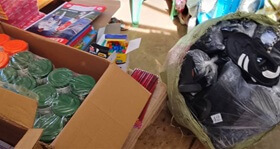
School bags, shoes, body lotion, toothbrushes, exercise books, pens, and pencils were among the supplies provided to 50 vulnerable schoolchildren through the Change for Children initiative at Koboko United Methodist Church in Koboko District, South Sudan.
The initiative helps reduce this burden while encouraging children to remain in school. Joseph called for stronger partnerships among churches, Muslim communities, government institutions, schools, and parents to sustain the project. Community fundraising initiatives, including collecting food items for sale and organizing annual school supply campaigns, have been proposed.
The project's impact was also reflected in the testimony of Janet Hamilese, an area leader, widow and member of the Roman Catholic Church, who described the support as particularly meaningful following the death of her husband earlier this year.
“My husband passed on this year, and things just changed. I am thankful for this donation. There was no discrimination, and The UMC considered all religions for the support. I have never seen such love. Even my relatives did not give me the support like I received today. Thank you once again,” Hamilese said.
Her testimony captures the heart of the Koboko initiative: A church extending its hand beyond denominational boundaries to meet human needs.
Bishop Wandabula acknowledged that the grant was only a beginning, stressing the importance of community ownership, accountability, and stronger partnerships to ensure sustainable support for vulnerable children.
“Our long-term vision is to build sustainable community partnerships that support education, protect children’s dignity and strengthen vulnerable families,” he said. He also thanked the Holston Foundation and other partners for believing in the children, expressing hope that the initiative would inspire other churches and communities to work together.
Juma Denis Daniel is superintendent of the Koboko District and lead communicator of the South Sudan and Koboko District of The United Methodist Church in Uganda refugee camps. Kudzai Chingwe is a communicator for The United Methodist Church’s Zimbabwe East Conference.
This story was published on November 4, 2026. The contact is Laura Buchanan


