
At a time when many families struggle to put food on the table, young adults in Angola decided to respond through one of the central expressions of the Christian mission: Service. Thus, the Global Kitchen Project was born—a solidarity initiative rooted in faith and love for one's neighbor, aimed at fighting hunger and restoring hope among the most vulnerable.
The project, led by the Young Adult Organization of The United Methodist Church in the Luanda Ecclesiastical District, distributes food and seeks to bring dignity to families, reminding them that they are not alone. Each bag of rice, liter of oil, and package of pasta represents an act of love and a demonstration that the Church remains present for those in greatest need.
“The Church’s mission does not end inside the sanctuary. It continues in homes, in communities, and alongside families facing hardship today. When we share bread, we also share hope and show the love of Christ in action,” said Mauro de Oliveira, coordinator of the Global Kitchen Project.
Combating hunger as an act of discipleship
According to the Food Insecurity Experience Scale report released by the National Institute of Statistics in 2026, Angola recorded a 6.9% reduction in the prevalence of severe food insecurity. The results suggest a mitigation of the most severe forms of food insecurity, though not the elimination of the problem, which remains significant in the country. In 2025, 70.9% of the population was experiencing moderate or severe food insecurity.
A call to support the Global Kitchen Project mobilized church members from the Luanda District, as well as young people, families, and community partners who responded with enthusiasm. The results exceeded expectations. More than 2,000 pounds of food was gathered, including rice, pasta, sugar, corn flour, cooking oil, beans, wheat flour, cassava flour, milk, salt, and eggs.
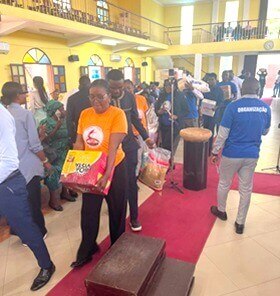
Young adults from Luanda showcase food items during the project presentation event at The United Methodist Church of the Redeemer.
For many volunteers, the experience was transformative. Maria de Lurdes, Deputy Lay Leader of the Luanda District, shared, “We realized that no one is so poor that they cannot share something. Every contribution, however small it may seem, will help a family smile again. This strengthens our faith and our responsibility as disciples of Christ.”
The project guidelines establish clear criteria for selecting beneficiaries, prioritizing United Methodists in proven situations of vulnerability, orphans, widows, individuals with chronic illnesses, unemployed youth, and families identified by local leaders as being in need of support.
Sharing God's love
The initiative aims not only to address an immediate need but also to create an enduring culture of solidarity and mutual care. Oliveira emphasized, “Our dream is that no family in our community goes hungry. We know we won’t solve every problem, but we can make a difference in someone’s life. That is what Christ teaches us.”
In addition to food distribution, the project includes social and spiritual support for the families served, strengthening community ties and fostering a support network rooted in Christian fellowship.
The Global Kitchen Project reaffirms The United Methodist Church’s historic commitment to holistic mission, demonstrating that true evangelism stems from bold love, joyful service, and courageous leadership alongside those who suffer most.
While expressing gratitude for the donors' generosity, the project coordinators issued a new appeal to the United Methodist community and social partners. Oliveira explains, “This work belongs to all of us. Every offering, every prayer, and every act of solidarity helps us transform lives. Let us continue hand in hand so that hope is never missing from any family’s table.”
Through initiatives like this, The United Methodist Church bears witness that faith finds meaning when it translates into service, and that God’s love continues to be proclaimed—including through a meal shared with those in greatest need.
Orlando da Cruz is a communicator for the West Angola Annual Conference.
This story was published on October 7, 2026. The contact is Laura Buchanan.


