
Ed Metzler, secretary to the bishop in the Indiana Annual (regional) Conference, and his wife, Erma, the conference’s communications assistant, distributed $50 worth of $1 and $5 bills Dec. 21 at a Goodwill Store as part of a Christmas outreach. A UMNS photo by Dan Gangler.
View in Photo Gallery
While we often envision a Christmas tree surrounded by presents in colorful paper with glittery bows, some of the most memorable holiday gifts come wrapped simply in love and kindness.
Here is a look at how some United Methodist congregations and agencies in 2011 kept Christ in Christmas.
Random acts of kindness
United Methodist Bishop Michael Coyner and 24 staff members of the Indiana Annual (regional) Conference took to the streets Dec. 21 during their Christmas luncheon.
Instead of a fancy holiday party away from the office, staff members used the money allocated for the meal, enjoyed a simple lunch and spent $625 on random acts of kindness. Each employee received $25 cash and printed cards saying, “You have been RACKed with a Random Act of Christmas Kindness.”
At 11 a.m., teams of two to four headed into the community. They returned two hours later to share stories of how their rapidly conceived plans played out.
Ed Metzler, secretary to the bishop, and his wife, Erma, a communications specialist, stuffed $1 and $5 bills into the pockets of clothing and purses at a Goodwill store.
“Such acts, small as they are, really do make the season of giving more meaningful,” Ed Metzler said. “I hope some children had their day brightened by the unexpected surprise of money in their new jacket or jeans.”
Accounting/payroll clerk Anne Hayton and three colleagues purchased and delivered pizza to families in a children’s hospital waiting room. One woman was with her little girl. When the volunteers walked in with a wagon full of pizzas, the mother’s face lit up.
“I felt so fulfilled to be able to brighten some people’s day and share the love of Christ,” Hayton said. “That is what Christmas and being a Christian is all about.”
Co-workers Lisa Timmerman and Carla Johnson went to a local restaurant. Combining their money, they surprised the waiter with a $30 tip and gave $20 to the cashier to pay toward the next person’s bill.
Conference employees also bought lunch for McDonald’s patrons going through the restaurant’s drive-in, donated money to a mission store, gave $10 gas cards to people outside a large retail store, paid for prescriptions for strangers at CVS, placed $50 worth of dollars and quarters by a hospital vending machine and visited a young woman who has epilepsy and contributed to her foundation to help others.
Kathy Entsminger, who works with the General Council on Finance and Administration, turned her late brother’s love for cozy footwear into an annual “Steve’s Socks” collection to benefit three agencies aiding displaced families. A UMNS photo courtesy of Kathy Entsminger.
View in Photo Gallery
Steve’s Socks warm feet … and hearts
“The definition of ‘inspire,’” said Kathy Entsminger of Nashville, Tenn., is “to affect, guide or arouse by divine influence.”
In 2008, Entsminger explained, she was inspired to collect new socks for the homeless. “My brother, Steve (Watkins), lost his battle with kidney cancer in 1999,” she explained. “My family always joked about how he loved new socks. He sold used cars for a living and never cared about the finer things in life, but … I can still see him, smiling and wiggling his toes in his new white socks.
“So did God whisper in my ear?” Entsminger wondered. “Did Steve somehow communicate the idea to me? I don’t know. I do know this: All I did was put the word out, and socks poured in like love from open hearts.”
Four years ago, at her workplace — the denomination’s finance agency — Entsminger started “Steve’s Socks.” At Christmastime, staff members collected socks to benefit three agencies aiding displaced families.
The first year — 2008 — she amassed 88 pairs. That number multiplied nearly 22 times the next year with 1,886 pairs, with a similar number in 2010. In 2011, she set a goal of 2,000. However, on Dec. 1, Entsminger already had 2,195 pairs. So she upped her goal to 3,000.
The final count? 4,329 pairs of socks.
Already looking ahead to Christmas 2012, Entsminger hopes some congregations will adopt the socks project.
“Having United Methodist church partners … would be fabulous,” she said. “I’d be happy to speak to them, teach them, direct them — whatever it takes to keep this legacy going and continue to put socks on those who desperately need them.
“For the veteran who was unable to pull his life back together after serving his country, for the mother who lost her job and her home and can no longer provide for her child, for the mentally challenged souls rejected by society, for the child who lives in a shelter with no home of her own … for all of the people with no voice, let me use my own voice to say thank you for caring.”
Congregation gives away entire offering
The counters on Christmas Eve at First United Methodist Church, DeKalb, Ill., were elated when they tallied up the offering — more than $14,000. The offering plate overflowed with generosity. But what makes this congregation even more generous? They gave the entire offering away!
“It was fantastic,” said the Rev. Brian Gilbert, associate pastor. “This church is so giving. This is what Christmas is all about.”
At a time when churches rely heavily on this yearend offering to ease strained budgets, First Church’s coffers benefited three social service agencies in the community including a food pantry, a transitional-living ministry for homeless individuals and families, and a shelter for battered women.
“The donation will help a lot,” said Gary Billings, the Salvation Army food pantry coordinator and a First Church member. “We have seen record numbers in the past few months. In October and November, we served over 700 families. We have never gone above 700.” He said the donation would help keep the shelves stocked, especially during the slow season when contributions typically falter.
“Believe it or not,” Gilbert added, “since we started doing this, our church finances have actually gotten stronger. I really think when people see the church acting with boldness, they want to be a part of it. People want to see their money being used in the community and helping others.”
The congregation also gives away loose coins dropped in the offering plate once a month to a designated charity, alternating between local and international organizations. In addition, members support a Good Neighbor Assistance Fund to help people in the community with utility bills, gas for cars and occasional help with rent payments.
“This church has a heart for giving and a heart for being active partners with others to meet the needs of those suffering in mind, body or spirit,” said the Rev. Jon Hutchison, pastor.
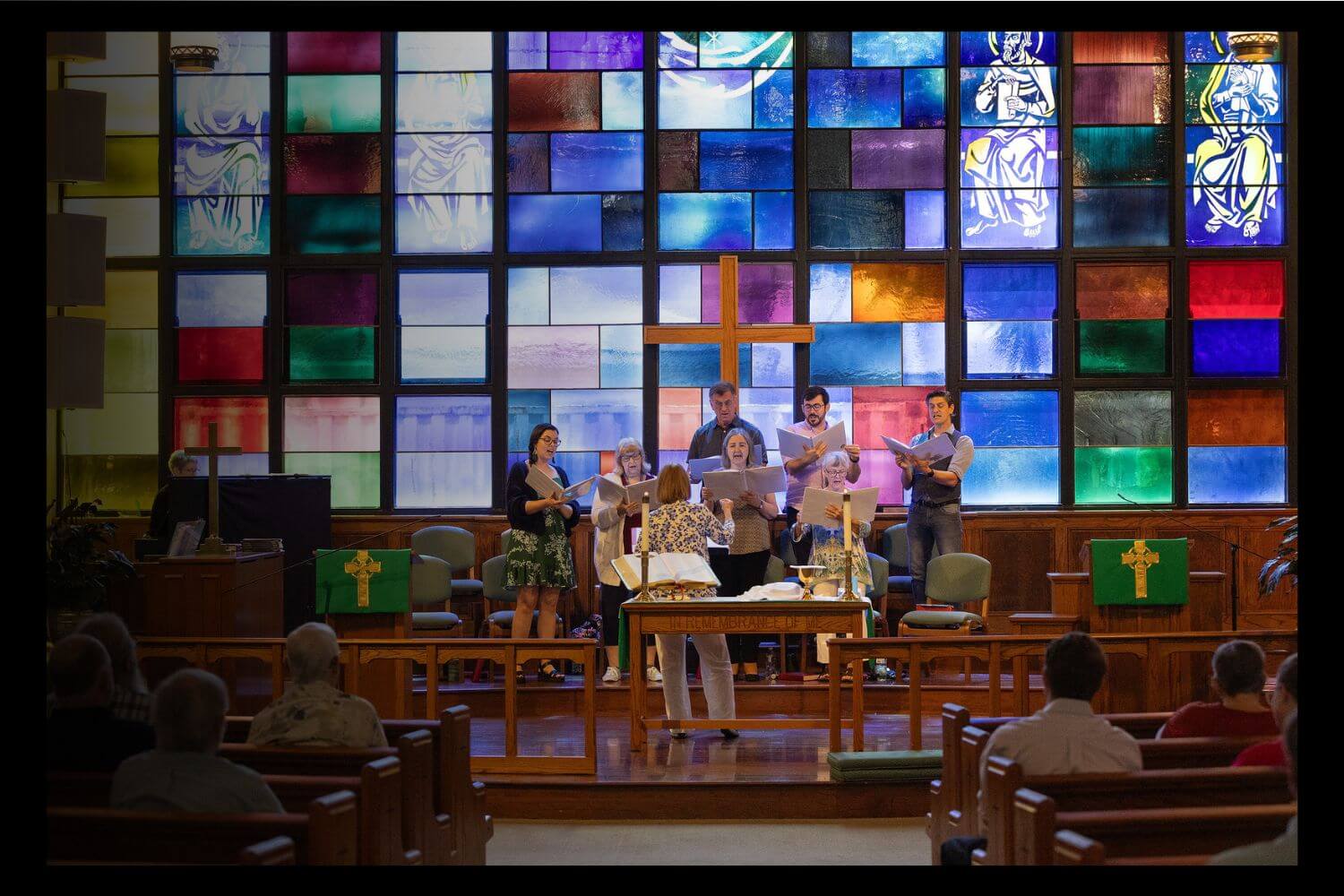
An impromptu choir sings together Christmas Eve at worship held at a renovated warehouse in Nashville, Tenn. A UMNS photo courtesy of Rethink Church.
View in Photo Gallery
Worship meets people where they are
Regular churchgoers have certain expectations around Christmas Eve worship: how the choir will sound, what the sanctuary will look like and how their favorite pew will feel. Remove all of those expectations and what do you have?
The Rev. Mack Strange of Brentwood United Methodist Church in Tennessee decided to try something different for Christmas Eve 2011. Securing a renovated warehouse, he teamed up with Ingrid McIntyre of Open Table Nashville Inc. to create a sacred space where people from all walks of life could come together to celebrate Christ’s birth and experience a different glimpse of God’s reign.
By getting away from the church’s suburban location, members reached new people where they were.
One person observed that it was as if adults returned to childhood during the impromptu choir formation. Previously solemn individuals jumped at the chance to participate, donning purple stoles and singing familiar Christmas carols to a slightly country beat. Gaiety turned to poignancy as the Rev. Justin Collett delivered a message about addiction, redemption and everyone needing a little bit of light. Those who have lived on the streets surrounding the warehouse understood, and when Holy Communion was offered, to some, it seemed like a kingdom feast.
The Rethink Church team at United Methodist Communications broadened the reach of this service to the online community at www.RethinkChurch.org. Digital advertising directed people to www.rethinkchurch.org/christmaseve, where they could watch and comment on the service (personalized through video co-hosts), send prayer requests to the Upper Room Living Prayer Center and find a church in their community.
In the early hours of dawn, Tagawunia Tarleton waits outside Sixty-First Avenue United Methodist Church in Nashville to receive a ticket to shop for her nine children at the Last-Minute Toy Store. A UMNS photo by Kathleen Barry.
View in Photo Gallery
According to the Rev. Paul Slentz, pastor of Sixty-First Avenue United Methodist Church, parents and guardians of 4,674 children and teens gave their families a happier Christmas, thanks to the generosity of others. Each participant received a ticket to choose new toys and gifts, plus books, oranges and candy canes, at no charge.
Reporting on the Faith and Leadership website, Fiona Soltes said, “But this is not an affluent church that just opens its pocketbook. The humble congregation, all but a few low-income themselves, offer their ongoing time, efforts and sense of ownership instead. The toy store — with more than 20,000 gifts worth some $200,000 donated by individuals and organizations citywide in the months preceding Christmas — is aimed at reaching those who have missed the deadline for toys from other agencies.
“It also draws hundreds of individual volunteers who join members of the congregation in pulling it off. Many volunteers receive assistance themselves.”
Slentz shared a thank-you note from one mother. “Thank you so much,” Sandra wrote. “You have given me hope in my heart. I was so worried that on Christmas morning, my little boy wouldn’t have anything. God bless and merry Christmas.”
*Dunlap-Berg is internal content editor for United Methodist Communications, Nashville, Tenn. Also contributing to this report were Daniel R. Gangler, director of communication, Indiana Annual (regional) Conference; Anne M. Gearhart, director of communications, Northern Illinois Annual Conference; and Neelley Hicks, assistant director, Communications Ministry Group, United Methodist Communications.
News media contact: Barbara Dunlap-Berg, Nashville, Tenn., (615) 742-5489 or newsdesk@umcom.org.
The magi follow the star in this sixth-century mosaic at the Basilica of Sant'Apollinare near Ravenna, Italy. A web-only public domain image.
“After Jesus was born in Bethlehem in the territory of Judea during the reign of King Herod, magi came from the east to Jerusalem. They asked, ‘Where is the newborn king of the Jews? We’ve seen his star in the east, and we’ve come to honor him.'” (Matthew 2:1-2, Common English Bible)
Just about every year at Christmastime, Nick Strobel can count on getting questions about the star that guided the magi.
Strobel is the planetarium director and a physical science professor at Bakersfield College in Southern California. As an astronomer and lifelong United Methodist, he has a certain affinity with the Bible’s most famous stargazers.
“We both have a love of the night sky,” said Strobel, a member of Wesley United Methodist Church in Bakersfield. “And, we search for a place or person where heaven and earth meet, and we both found that in the person of Jesus.”
The biblical account of the magi does not quite match the typical church Christmas pageant image of three little boys in scratchy beards and lopsided crowns dropping gifts by the baby Jesus’ manger.
Nick Strobel, A web-only photo courtesy of Nick Strobel.
Instead, in Matthew, the wise men visit the holy family in a house in Bethlehem some point after Jesus’ birth. The number three probably derives from the three gifts they brought to the Christ child — gold, frankincense and myrrh.
The magi — called magoi in the original Greek — were likely sages and astrologers. The tradition that they were three kings named Gaspar, Melchior and Balthasar developed centuries later.
On this the Bible and Christmas tradition do agree: The magi found the newborn king by following a star.
The ancients believed God would make destiny manifest in the stars, said Gregory J. Riley, New Testament professor at United Methodist-related Claremont (Calif.) School of Theology. So, it was no surprise that Jesus’ birth was accompanied “by the appearance of his star in the very fabric of the heavens.”
The exact nature of that heavenly body has been a source of speculation — for Bible scholars, children’s book authors, astronomers and, in recent decades, planetarium audiences. Discussion of the star is part of Bakersfield College’s annual December planetarium show, “Season of Light,” which Strobel hosts.
“…And look, the star they had seen in the east went ahead of them until it stood over the place where the child was. When they saw the star, they were filled with joy.” (Matthew 2: 9-10)
Since the night sky can vary greatly depending on the year and season, Strobel first needed a good estimate for Jesus’ birth year to evaluate these possibilities.
The Bible does not give Jesus’ exact birth date. However, many biblical scholars and historians now think Jesus most likely was born around 6 to 4 B.C., and Strobel uses those years in his dating. That puts Jesus’ birth sometime near the death of Herod the Great (the wicked Herod mentioned at the beginning of Matthew) and Jesus’ ministry during the early years of Pontius Pilate (the wicked Roman governor in all four Gospels).
What are frankincense and myrrh?
While you will not find gold, frankincense and myrrh on a typical baby registry, the gifts certainly were fit for a king.
Gold’s value is self-explanatory. But, in many ways, frankincense and myrrh were just as desirable among royalty. Frankincense and myrrh — both rare, fragrant resins — were used in incense and perfumes.
Because myrrh also was used to preserve corpses, many Christians have long seen the magi’s gift as foreshadowing Christ’s death. The carol “We Three Kings of Orient Are” connects myrrh to the “gathering gloom.”
Many ancients would have associated myrrh with burial, said the Rev. Ben Witherington III of Asbury Theological Seminary. Myrrh also could serve as a narcotic, he said, and in that capacity, it featured in the Crucifixion. In Mark 15:23, Jesus on the cross was offered — and refused —wine mixed with myrrh. In John 19:39, Jesus later was buried with myrrh and aloe.
Alicia D. Myers, New Testament professor at United Theological Seminary, doubts the Gospel of Matthew’s earliest readers would have linked the magi’s present with the coming tomb.
“In Matthew we have no explicit connection between death and myrrh,” she said. “Instead, the context of Matthew 2 highlights the expensive nature of the spice as a costly gift alongside the gold and frankincense. I am more inclined, then, to understand the myrrh as yet another move by Matthew to reinforce Jesus’ kingly status rather than reading it as an allusion to his coming death.”
However interpreted, the gifts of the magi continue to inspire Christmas generosity each year.
—Heather Hahn
Strobel points to four natural phenomena that some astronomers think might explain the celestial sighting: a nova, a comet, a planetary conjunction and Jupiter’s retrograde motion.
Nova
Chinese astronomers, Strobel said, recorded that a new star (or nova) appeared in the constellation Capricorn during March and April of 5 B.C. A nova is actually a white dwarf — that is, a dying star — that has gathered enough material, usually from another nearby star, to build up pressure and explode. A nova quickly peaks in brightness within a few days and then fades to invisible over a few months.
The nova the Chinese spotted would have first appeared in the east (that much fits with the Gospel of Matthew). However, that nova would not have visibly moved much as the magi headed toward Bethlehem, which is why Strobel sees it as an unlikely candidate for Star of Bethlehem status.
Comet
Many ancient cultures, including the Chinese, regarded comets as heralds of important events. Trouble is, there are no comet sightings recorded around 6 to 4 B.C. Strobel said Halley’s Comet made a swing by earth in 12 B.C., too early to portend the Bethlehem birth. That’s probably a good a thing. The ancients typically viewed a comet as a bad sign — not a proclamation of joy to the world.
Planetary conjunction
Planetary conjunctions, where two or more planets appear very close together in the night sky, may not make the headlines today the way comets do. Still, Strobel thinks such a conjunction is a much likelier prospect for the nativity’s starring role. And, astronomically speaking, 7 to 6 B.C. were good years for conjunctions.
In late May, late September and early December 7 B.C., Jupiter and Saturn moved past each other three times in the constellation Pisces. Such an occurrence happens only once every 900 years. The following February, Mars, Jupiter and Saturn formed a near conjunction in Pisces, which happens once every 800 years.
The combination of Jupiter and Saturn would have seemed especially auspicious to these astrologers in the Near East, Strobel said. Jupiter symbolized royalty, and Saturn represented the Mesopotamian deity who protected Israel. In addition, ancient astrologers associated Pisces with the Jewish people.
“(The wise men) would have been aware of the sky and probably kept records of the sky going back centuries,” Strobel said. “They would have known this was a rare occurrence. They’d think, ‘Well maybe this is telling us that something really interesting is going to be happening there in Israel.’”
Jupiter’s retrograde motion
If the wise men were in need of a further sign in the heavens, they got one in 5 B.C., Strobel said. That year, Jupiter, instead of “wandering” eastward as planets typically appear to do, seemed to stop and then go backward among the stars in what astronomers call a retrograde motion.
Strobel compared the motion to what happens when a car accelerates past another car. It makes the slower vehicle look like it is standing still and then receding. In 5 B.C., earth passed Jupiter and it appeared to be stationary for about a week — perfect for hovering in place over a momentous birth.
Among the various astronomical possibilities, Strobel thinks that the planetary conjunction and stationary Jupiter theories probably get closest to what the magi might have seen.
The three wise men appear before King Herod in this stained-glass window by an anonymous artist. Despite their crowns, the magi were not kings in the Bible. A web-only public domain image.
“They entered the house and saw the child with Mary his mother. Falling to their knees, they honored him. Then they opened their treasure chests and presented him with gifts of gold, frankincense and myrrh.” (Matthew 2: 11)
The Rev. Ben Witherington III, a United Methodist elder and New Testament professor at Asbury Theological Seminary in Wilmore, Ky., agrees that astronomical phenomena could help explain the magi’s guide. But, he points out, the magi like most ancients would have seen stars and other celestial objects as living beings — much like “the heavenly host” that visited the shepherds.
While it’s fun to speculate, Strobel said, the nature of the star does not matter to his faith. In fact, he would not care if Matthew made up the whole story of the magi.
“He was not writing a science textbook or newspaper account,” Strobel said, “but rather a book to persuade people that this person called Jesus was the Son of God, one who should be worshipped, and one who showed us how to live as God wants us to live.”
The story of the nativity contains a deeper truth than can be found in any star chart, he said.
“God, the infinite power of the universe, is just so willing and wanting to have a relationship with us that he became a powerless infant who had to be cared for,” he said. “That’s pretty amazing that God would be willing to do that.”
*Hahn is a multimedia news reporter for United Methodist News Service.
News media contact: Heather Hahn, Nashville, Tenn., (615) 742-5470 or newsdesk@umcom.org.
Editor’s note: UMNS first profiled Glen Fisher, a modern-day shepherd, in 2010. The Texas drought has taken its toll this year on his ranch. Because of a lack of feed, he has sold 75 percent of his cattle and about 60 percent of his sheep to ranchers elsewhere with greener pastures. But with the approach of Christmas, Fisher sees reasons for hope. The past few weeks have brought much-needed rain to his southwest Texas community, and this season of birth is bringing the welcome addition of lambs. “I keep telling people that I guess that the Lord doesn’t want me to be a rancher anymore, but he hasn’t told me what to do yet. So I keep listening,” Fisher said.
A UMNS Feature
By Heather Hahn*
1:00 P.M. EST December 23, 2010
Modern-day shepherd Glen Fisher keeps a watchful eye on his flock. Photos courtesy of the American Sheep Industry Association.
View in Photo Gallery View video
"Nearby shepherds were living in the fields, guarding their sheep at night. The Lord’s angel stood before them, the Lord's glory shone around the, and they were terrified." (Luke 2:8-9, Common English Bible)
Each Christmas Eve when he hears the familiar account of the shepherds’ angelic visit, Glen Fisher has good reason to sit up a little straighter in his pew.
The United Methodist has herded sheep for more than 30 years on his ranch near Sonora in southwest Texas, and he is a respected leader in his profession. In January, Fisher will complete his two-year term as president of the American Sheep Industry Association, the national organization that represents the 82,000 sheep producers in the United States.
Sheep remain an integral part of U.S. agriculture. Farm flocks are raised in all 50 states, providing wool for mills as far away as China and meat for dinner tables closer to home. Fisher’s home state of Texas has the nation’s largest share of the industry, with more than 10 percent of the nation’s sheep producers and some 830,000 sheep and lambs as of this past January.
But Fisher, 63, takes special delight in being part of a profession referenced throughout the Bible and knowing that shepherds like him were among the first to hear the good news of Christ’s birth.
“I’m quite proud that even today all the Christians in the world know about shepherds and their sheep,” he says.
A baby lamb nurses under the shelter of a mother ewe in a rustic barn. Fisher said sheep are good mothers.
View in Photo Gallery
"The angel said, 'Don’t be afraid! Look! I bring good news to you — wonderful, joyous news for all people. Your savior is born today in David’s city. He is Christ the Lord.'" (Luke 2:10-11)
Fisher’s work does not quite fit the standard Christmas greeting-card image of shepherds calmly caring for flocks with a shepherd’s crook and staff as their only tools.
These days, Fisher tends his flock of 1,800 ewes and about 60 rams with a big blue Ford pickup, a feed buggy and the help of two ranch-hands.
He mainly checks to make sure his livestock, which also includes cattle and goats, have enough water and feed in their concrete troughs. It is dusty and time-intensive work. Even with the feed buggy, it takes a man two days to feed all the livestock on his property. The feed troughs typically need refilling every 10 days.
He also checks the condition of the pasture, sees if any fences need mending and looks for the tracks and droppings of any potential predators.
Many people characterize sheep as dumb, but Fisher says that’s not entirely true. He has seen sheep fight off coyotes to protect their young. Ewes can always identify their lambs by the sound of their “bahs.”
“They are pretty smart animals,” he explains. “But there are times when they can try your religion. When you are trying to get them into a pen and they just stare at you, you get mad and say the words you shouldn’t.”
His big worry, for now, is the drought that has parched his community since late September. December is Fisher’s lambing season, and seeing the lambs play and climb is usually his favorite part of the job. However, he now has more mouths to feed and thirsts to quench. The dry weather means he has to spend more money on feed.
So, lately, he has spent a lot of his time praying for relief. “I try to remind the Lord every day if he wants me to be a good shepherd, I need a little help here with a little rain,” he says.
He does not watch his flocks by night. He has metal pens to help keep the sheep safe. Still, he can identify with the frightened shepherds of Luke.
“They cared for their sheep because the sheep took care of them,” he says.
Fisher speculates that maybe God chose the shepherds for the special birth announcement to show that God cares for people just as much as a shepherd cares for his sheep.
"Suddenly a great assembly of the heavenly forces was with the angel praising God. They said, 'Glory to God in heaven, and on earth peace among those whom he favors.'" (Luke 2:13-14)
In Jesus’ day, shepherds were not generally on the guest list to see a newborn king.
Their work, however, was essential. Sheep were important sources of milk, meat and wool, and were also an essential part of Jewish worship at the temple in Jerusalem.
Nevertheless, shepherding itself was a dirty and at times lonely job, United Methodist scholars point out. Shepherds were peasants who could not support themselves from the land and had to work as hired hands.
“In fact, many would have regarded shepherds as ritually unclean, especially if they were involved not only in wool gathering, but in slaughtering animals and tanning hides,” says the Rev. Ben Witherington III, a blogger at Beliefnet.com and New Testament professor at Asbury Theological Seminary in Wilmore, Ky.
“Bethlehem was the ancient equivalent of the stockyards in Kansas City. It was where the sheep were raised and kept to be sent off to slaughter six miles up the road in Jerusalem.”
The angels’ annunciation to humble shepherds is very much in keeping with Mary’s pronouncement earlier in Luke that God has lifted up the lowly, says the Rev. Richard Hays, the dean of Duke Divinity School and a New Testament professor.
One of the themes of Luke’s Gospel is divine reversal. “Luke is showing that no person is considered beneath the Messiah's dignity, and all should celebrate his coming for as Luke says — he is the savior of the world,” Witherington adds.
A large flock of sheep are pictured against hills in southwest Texas.
View in Photo Gallery
"They went quickly and found Mary and Joseph, and the baby lying in the manger. When they saw this, they reported what they had been told about this child. Everyone who heard it was amazed at what the shepherds told them."(Luke 2: 16-18)
Fisher has never felt disparaged for his line of work, and indeed it has long been a fruitful livelihood for his family.
His wife Linda’s family has been sheep ranching in southwest Texas since the 1880s, and his son recently began tending his own flock at a ranch inherited from a cousin.
Sheep ranching has been particularly important to the members of Fisher’s congregation, First United Methodist Church in Sonora. The church’s building, erected in 1928, was funded in part by the women of the church selling 50 sheep.
About 30 to 40 percent of the church’s worshipers work in sheep ranching, says the Rev. Earl Ray Wells Jr., the church’s pastor. And just about everyone in the church, which has a weekly attendance of 70, has some connection to the sheep industry.
A stained glass window in the church of Jesus as the good shepherd pays tribute to the congregation’s lasting connection to flocks of a woolly sort.
Linda Fisher, who has been an administrator at the church for 15 years, says caring for sheep at times can make her feel closer to God.
“You know when you’re in between big buildings and you can’t even see the sunset, you have to remind yourself a little harder about God’s gifts,” she says. “I can be driving in from the ranch and see a sunset any day I want to, and I see what God has done for us.”
*Hahn is a multimedia news reporter for United Methodist News Service.
News media contact: Heather Hahn, Nashville, Tenn., (615) 742-5470 or newsdesk@umcom.org.
The three words that best describe you are as follows, and I quote: Stink, Stank, Stunk.
— “You’re a Mean One, Mr. Grinch,” lyrics by Theodor “Dr. Seuss” Geisel
UPDATE: Chilcutt United Methodist Church in rural east Tennessee has won its war with the skunk or skunks that tunneled under the 157-year-old church building. The Rev. Erbin Baumgardner says, " We finally got rid of all the skunks, the church smells much better and we had our Christmas program on Sunday night." Baumgardner sent a special thanks to Annette Spence, editor of The Call in the Holston Annual (regional) Conference for "an excellent job in taking a 'stinky' problem and turning it into a 'sweet smelling story.' "
A UMNS Feature
By Annette Spence*
3:00 P.M. ET Dec. 16, 2011
| CLEVELAND, Tenn. (UMNS)
The Rev. Erbin Baumgardner (left) and H.L. Lowe (right) stand by the sign proclaiming “Skunk Stole Our Christmas” in front of Chilcutt United Methodist Church in Cleveland, Tenn. UMNS photos by Annette Spence.
View in Photo Gallery
For almost two weeks, members at Chilcutt United Methodist Church in rural east Tennessee have fought the most odiferous fight.
It all started on Dec. 3, when member H.L. Lowe opened up the church doors to find incense so intense, “it looked like London fog in here.”
Lowe, 60, and his pastor, the Rev. Erbin Baumgardner, 69, deduced that a skunk (or skunks) had tunneled below the church. “I’m afraid he became irritated somehow and sprayed the building,” the pastor said.
The doors of the 157-year-old church were left open all day to air out the building. The next morning, the odor was still so strong that Sunday school and worship had to be cancelled.
“This is a country church, and skunks live in the country,” Baumgardner said of the church on Chilcutt Road, bordered with cow pastures. “Sometimes, you’ve got to sit back and laugh at the situation, but we still weren’t going to let a skunk take away our Christmas.”
The battle begins
On Monday morning, the “war of the noses” began. Lowe and fellow church member Ted Vore poured concrete into the holes where the pesky visitor had dug under the building. They bought five gallons of industrial-strength air freshener (lilac scented) and pumped it through the building’s vents.
It didn’t work.
So on Tuesday, they hired an exterminator to spray a super deodorizer that smelled like fabric softener throughout the building. Lowe and Vore followed that up with five gallons of vinegar and five gallons of ammonia, which they pumped through the vents.
On Wednesday night, church members returned to the building for Bible study. The odor was still there, awaiting their arrival.
“Those who attended had to wash their clothes to get the smell out,” Baumgardner said.
“My hands smelled like skunk. My hair smelled like skunk,” Lowe said. “Even the rubber on my cell phone smelled like skunk.”
Lowe and Vore tried pumping peppermint extract through the vents, “so then it smelled like skunk and peppermint in the church,” Lowe said. When newly dug holes appeared around the church, the men set traps to try to eliminate the source of the smell. They used peanut butter, honey buns and sardines as bait.
Sunday, Dec. 11, arrived. Several worshippers arrived, only to take a whiff and get back in their cars. A few “brave souls” stayed, Baumgardner said, but worship attendance was “way down” from the usual 60.
Desperate, the church leaders called Wildlife Technicians on the morning of Dec. 12 and promptly learned that sardines and peanut butter aren’t proper skunk bait.
Cereal and fireworks
“Froot Loops?” Lowe asked incredulously, when the “wildlife removal specialists” began to set up traps around the picturesque church lot.
A day later, church member and neighbor Jackie Evans spotted three skunks on the premises. Two perpetrators were later caught; at least one remains at large. Lowe has since hit upon trying sulfur bombs from the fireworks store to help kill the odor — and it seems to have worked. “Can you smell any skunk?” he asks a visitor.
So far, Lowe says, the church has spent about $400 on skunk-fighting supplies and services, and the carpet and pew cushions still have to be cleaned. All this in a year when the church had to spend $22,000 in building repairs from the April tornadoes.
With just one week to go before Christmas, Dec. 18 is a big day. In addition to regular worship and Sunday school, the children’s Christmas program — postponed since last week — is on the agenda.
Lowe has 12 more sulfur bombs to set off, and the Froot Loops are carefully and tantalizingly displayed. He’s also thinking about pumping a combination of cinnamon and peppermint extract through the vents.
“Or how about pine? Or cedar?” asks Baumgardner.
Standing in the sanctuary with the sun streaming through the windows and the smell of fireworks in the air, the two men seem deep in thought.
*Spence is the editor of The Call at the Holston Annual (regional) Conference.
News media contact: Maggie Hillery, Nashville, Tenn., (615) 742-5470 or newsdesk@umcom.org.
Advent is a time of preparation as children light the second candle of the family advent wreath. An Interpreter file photo illustration by Ronny Perry.
View in Photo Gallery
Shopping on Black Friday — DONE!
Supporting Small Business Saturday — DONE!
Worshipping on the First Sunday of Advent — DONE!
Online ordering on Cyber Monday — DONE!
The gift buying, tree decorating, party planning and other pre-Christmas tasks can easily overshadow Advent and spiritual preparation for remembering Christ’s birth. While Advent 2011 began on Nov. 27, 25 days remain before Christmas, plenty of time to use Advent devotions and activities delivered via email, downloaded to your computer or mobile device or accessed on the Web.
“The Journey” Smartphone app is based on the new book by the Rev. Adam Hamilton, but it also functions as a standalone Advent calendar. The app, available for iPhone, iPad and Android devices, opens with seven unlocked activities for children. A new one (videos, coloring sheets, puzzles, cards, Bible quizzes) opens daily starting Dec. 1.
A daily online retreat offers group discussion in addition to Scripture reading, reflection and guided prayer practices. Upper Room Ministries, a part of the United Methodist Board of Discipleship, and www.BeADisciple.com are sponsoring the Nov. 27 – Dec. 25 retreat based on “Behold! Cultivating Attentiveness in the Season of Advent,” a new book by Pamela Hawkins.
Lighting the candles of an Advent wreath weekly or daily allows individuals and families to focus on the coming of Christ into the world. If you missed lighting a candle on the first Sunday of Advent, choose another time this week to do so and then continue the tradition for the next three Sundays, beginning Dec. 4, and on Christmas Eve.
The Board of Discipleship’s worship resources staff offers weekly candle lighting meditations to use throughout Advent. Each includes a Scripture reading, short prayers and one stanza of a hymn or song. For those without an Advent wreath, Dean McIntyre, discipleship’s director of music resources, suggests, “Use candles alone — four of similar size and color for the four Sundays (purple or blue is traditional), and a white candle in the center for Christmas Eve.”
Advent wreath lighting liturgies can also be downloaded from the United Methodist Board of Global Ministries' website and adapted for home use. Each uses a verse of the song “Yalla magg na” (Senegalese for “The Child of Hope is Coming”), Scripture and prayers. Among the meditation writers is John Daniel Gona, who served as a global ministries’ mission intern with the Wi’am Palestinian Conflict Resolution Center in Bethlehem.
Free daily Advent devotions with the theme of “Passing the Peace” aredelivered daily by email from the Society of St. Andrew. Writers reflect on where they have witnessed or been an instrument of God’s peace in the world. Each email includes a link where readers can donate to Society of St. Andrew’s hunger-fighting ministry in the United States.
“Expecting the Word” is a free daily devotional study, which can be read online or downloaded. The National Council of Churches published the study, based on the texts for Advent from the “Revised Common Lectionary,” through its Justice for Women’s Working Group. The United Methodist Board of Church and Society is part of the group.
Marsha and Bishop Michael Coyner enjoy a meal with his parents, Nina and Jake Coyner. Photo courtesy of Bishop Michael Coyner.
View in Photo Gallery
This will be our family’s first Christmas after the death of my mother, so it may be rather bittersweet. Mother always loved Christmas, and she and Dad always decorated the house thoroughly. We kids often joked that if one stood still too long, they might put Christmas lights on you.
My folks have always been very generous at Christmas and other times, too. Even after we went to a plan of drawing names for Christmas gifts among family members, they always “cheated” and did extra giving. Family gatherings at Christmastime were always filled with joy, sharing, game playing, singing carols around the piano and, of course, lots of good food.
So this Christmas may be more of a “Blue Christmas” for us who, like so many of you, are experiencing our first Christmas after the death of a loved one. In fact, I previously have written to recommend to our churches that they consider hosting a “Blue Christmas” or “Longest Night” service for those who are grieving this time of year. Simply going forward with the usual joyful activities is not always an easy choice when you have a lost a loved one since the last year’s celebrations. I urge our churches to be sensitive to those who are facing these holidays with the bittersweet feelings of both joy and sadness.
However, I also know that good Christmas memories can carry us through tough times and periods of grief. My own memories of Christmas are filled with images of family, faith and fun. My best Christmas memories include the times when Mother and Dad had a Jesus Birthday Cake, which we shared on Christmas morning. It helped us young kids remember that Christmas is not just about our own gift-giving and receiving; it is about the greatest gift.
I remember times when Marsha and I took our young children, Steve and Laura, to help deliver Meals on Wheels on Christmas morning. Of course, I remember many wonderful Christmas Eve worship services and times of sharing the joy of the Christ Gift through singing, preaching, candles and “Silent Night” rituals.
I invite you, your family and your church to consider these questions:
What kind of Christmas memories will you be making this year?
What things will you do this year for Christmas that will become sustaining memories for years to come?
In what ways will your community and your world be blessed by what you do this Christmas?
Those wonderful Christmas memories from the past did not happen by accident. My parents and my home church planned those events and made it possible for me to have cherished memories that will endure through this bittersweet Christmas of 2010.
How about you, your family and your church? How will you work to provide the kinds of cherished memories that will sustain you and others for years to come?
Make some Christmas memories this year. You will be glad to have them in the future.
*Bishop Michael Coyner serves the Indiana Area of The United Methodist Church.
News media contact: Barbara Dunlap-Berg, Nashville, Tenn., (615) 742-5489 or newsdesk@umcom.org.
“We swim in a sea of consumerism 365 days a year,” declared Joseph Roitz, an Arkansas United Methodist.
Those choppy waters can drown consumers in debt and regret that much of our “generosity” quite honestly does not reflect the spirit of Christmas.
The antidote for many congregations is an alternative-giving fair or marketplace where shoppers discover that compassion, not consumerism, is the best way to honor the Christ-child.
Roitz explained the rationale behind the alternative-giving opportunities at Lakewood United Methodist Church, North Little Rock, Ark., where he heads communication ministries.
“First, we're working to help our congregation give of themselves by doing what they normally do, but in different ways.” The prayer-shawl ministry team knits mittens and hats for children, the youth work at a compassion center and a food pantry, and the bell choir entertains at nursing homes.
“Secondly,” Roitz added, “we're using signs on the jammed streets leading to a local major mall within walking distance of our church to invite the shopping public to learn how to give more and spend less.”
But the congregation offers just one very important gift choice: water.
“The person who is so hard to buy for, who seems to have everything, also has clean water they take for granted. It's the perfect way to give in a way that is meaningful, that represents what we're trying to accomplish through discipleship—and symbolically, what better helps us remember our baptism?”
Giving gifts that matter
In most instances, the church invites local, national and international organizations to set up booths to share information about and sell products related to their ministries. Some, like First United Methodist Church, San Diego, offer online buying. Shoppers select an organization or gift that fits each recipient’s interests.
For example, instead of buying a wrap-able present for a carpenter, the giver donates in the recipient’s name to Habitat for Humanity International to buy building supplies for a house. If a coffee-lover’s name is on the Christmas list, fair-trade coffee is the answer. In developing countries, fair trade for coffee farmers means community development, health, education and environmental stewardship.
Choose an alternative gift from The Advance gift catalog that will support vital mission projects around the world.
A resource for meaningful gift ideas is The Advance website, which features the Hope for Christmas catalog. The Advance is The United Methodist Church’s official designated-giving program through which 100 percent of every contribution goes to the ministry the giver selects.
At some alternative-giving fairs, volunteers handcraft cards to tell recipients about the gifts given in their honor, while others provide a place where shoppers can create their own cards.
The missions committee sponsors the alternative fair at Huntington United Methodist Church, Shelton, Conn., but families and groups within the congregation host the tables.
The event is important for many reasons, believes the Rev. Timothy Hare, whose family does 90 percent of its holiday shopping at the event.
“People in dire situations all over the world . . . benefit from our fair,” he said. “Shoppers have helped to feed the hungry in the U.S.; they have assisted in the process of emancipating young women from sexual slavery in Asia; they have provided disaster relief to people all over the world; they have provided refugee care, medical care and more to people who desperately need it.
“As we become more attuned to the plights (of others), we build a sense of community with people whom we will likely never meet.”
First United Methodist Church in Tallahassee, Fla., has offered its alternative market for 24 years. Since its inception, the event has raised more than $800,000, and each year's total is bigger than the last.
“We have 30 non-profit organization booths in our fellowship hall and about 20 more in our card-and-craft shop, which includes items from SERRV,” said Cindy Cosper. The mission of the non-profit SERRV is to eradicate poverty by providing opportunity and support to artisans and farmers worldwide.
Cosper compared the event to a love feast. “Even if you buy nothing, you get a good education from caring people.”
Encouraging peace . . . ecumenically
In Riverside, Calif., First United Methodist Church is opening its doors to the interfaith community for a holiday alternative-gift fair. Now in its 29th year, the fair will include a band and a booth from a nearby synagogue and a Hindu musician, as well as Christian groups that traditionally have participated.
"We'll put the fair-trade coffee on,” said Kris Lovekin, co-chair of the event, “and there will be plenty of beautiful crafts, from hand-knit sweaters to Nativity sets made of olive wood and decorative menorahs.
At Huntington United Methodist Church, Shelton, Conn., member Diane Walsh greets visitors during the 2009 alternative fair. File photo courtesy of Huntington UMC, Shelton, Conn.
“This is a way for people of good conscience to buy holiday gifts for their friends and loved ones that will protect God's creation and offer a fair and respectful living to people who are struggling. It is sustainable living. It is fair and just. And it is the gift that keeps on giving. Plus, the fair itself . . . creates a fellowship that encourages peace.
“We enlarged the circle this year to include more faiths,” she explained, “because the season of gifts is a universal experience. It benefits us all to fellowship with people of all faiths, respecting their traditions, and with no expectations for them to believe any particular thing.”
Wesley United Methodist Church, Bloomington, Ill., is trying an alternative Christmas market for the first time.
Bettie W. Story of the missions committee encouraged the congregation to “spread joy to people in this community and around the world through local and global organizations of your choice.”
She offered two of many examples.
“Your swarm of honeybees will go through Heifer International to a family either in the U.S. or abroad who needs to have a source of income; your gift of $20 will purchase blood-pressure medicine for 33 patients through the (local) Community Health Care Clinic.
“How much easier could Christmas shopping be?”
*Dunlap-Berg is internal content editor for United Methodist Communications.
News media contact: Barbara Dunlap-Berg, Nashville, Tenn., (615) 742-5489 or newsdesk@umcom.org.
Visiting family over the holidays for many means walking a proverbial tightrope of emotions. A UMNS photo illustration by Kathleen Barry.
View in Photo Gallery
You’ve been to see your therapist for a “booster” session. You’ve refilled your prescription for anti-depressants. You’ve practiced your positive affirmations. You’re feeling good. You’re feeling strong. There’s no doubt in your mind that this year you can handle the holidays with your family.
“This time definitely will be different,” you tell yourself.
Yeah, right.
Despite your best efforts to prepare yourself for the worst in what are supposed to be the best of times, it all falls apart the minute the past creeps back into the present.
Grandma Minnie mentions you look like you’ve gained a few pounds. Your sister teases you about your non-existent love life. Your liberal brother angrily debates politics with your conservative father. Mom is so busy people pleasing she doesn’t even ask you about your promotion at work. Before you can say “Ho! ho! ho!,” you’re back to being 15 years old again and feeling hurt, resentful or furious.
And all the years of expensive therapy disappear along with expectations of Kodak moments and hopes for a holly, jolly Christmas.
Reality check.
“People too often think that they’ll go home for the holidays, and it will be different,” said Amy Birchill, director of St. Luke’s Center for Counseling and Life Enrichment, a United Methodist ministry in Houston. “They think, this year we’ll all get along. Or I’ll see my family again, and it will be a great thing. But they don’t take into account that they can’t undo perhaps years of dysfunctional relationships in just one holiday weekend.
“If you go back with different behaviors and a different outlook,” she added, “you have a chance of making things different and having a pleasant time. But if you go back and (replay) those family roles that you were always in, then it’s going to blow up again … especially if you’ve changed, but others haven’t.”
Feeling like a teen again
Amy Birchill, director of St. Luke’s Center for Counseling and Life Enrichment in Houston. A web-only photo courtesy of Amy Birchill.
Jack, a United Methodist pastor, knows the right things to say and do when it comes to encouraging and advising others dealing with holiday stress — especially managing family dynamics.
But when he makes the five-hour trip home to “celebrate” Christmas with his parents, grandparents and brothers, he reverts to being the middle child who bickers with his younger brother, argues with his father and absorbs the stresses between his parents and grandparents.
“When I’m away from home, I am a capable 29-year-old United Methodist minister who people look up to,” he said. “I can usually hold it together and keep perspective on life’s challenges. But when I go home, I become someone trapped by the same challenges that I’m supposed to be able to overcome in the ministry. I become the teenage son again.”
Janice can relate. She, too, becomes a different person with her family than she is in the pulpit.
“I always feel like I have to tread very lightly,” she said. “I think I have to watch what I say and what I do, and most of the time, I can’t be myself. There’s a lot of pressure not to do anything that will upset anyone, and that reminds me of growing up.”
Her mother had a history of mental illness. Especially at Christmastime, her father would warn her not to argue with her mother. “We don’t want her to have to go back into the hospital,” he would say.
Now when she visits family at Christmastime, Janice ends up wanting to follow the example of Dorothy in "The Wizard of Oz." She wishes she could click her heels three times and just be gone.
A healthy place for the holidays
So why do we do it? Are we gluttons for punishment? What would happen if we just said “no” to the invitation to gather with family this holiday season? Birchill warns despite possible consequences, in the end, it could be the healthiest thing we do for ourselves.
“If you’re going through a challenging time and you know it will be bad for you to go home, I think you have to protect yourself,” Birchill said. “You can say, ‘I’m not coming. I have other plans.’ Or you can say, ‘This year, I just really need to stay here and take care of myself.’"
Whatever your decision, be prepared for a reaction, she added.
“You always have a right to choose to do what you want to do,” she said. “And you really should be looking out for yourself and what’s going to make you healthy and keep you in a good place.”
Rather than bemoan the fact your family doesn’t live up to the happy hype of the holidays, Birchill recommends creating a healing community within your reach that can support you and keep you going.
“For a lot of folks who are in dysfunctional families and have mental-health issues or other things that are not really healthy in their families, they leave those family settings and create their own,” Birchill said.
“It’s incredibly important because that is part of what does keep you healthy and what does allow you to grow in different ways,” she added. “If you don’t like the way you act when you’re around this one group of people, then being around a new group of people that you feel comfortable with and safe with helps you change your own behaviors so that you feel like a different person.
“We can’t change without the benefit of perspective and influence of others.”
Just remember you are not alone. Even some of the families in the Bible were dysfunctional. The dynamics among Joseph and his brothers in Genesis, for example, aren’t exactly the stuff of Norman Rockwell illustrations. But God can be present in even deeply flawed families, and God can help us love our relatives anyway — even when they drive us crazy.
*Passi-Klaus is a staff writer on the Public Information Team at United Methodist Communications.
News media contact: Heather Hahn or Tim Tanton, Nashville, Tenn., (615) 742-5470 or newsdesk@umcom.org.
Related Audio
Amy Birchill: “You can’t do every single thing that everybody else wants to do.”
Amy Birchill: "Different experiences have led you to become the person you are now."
What if we just stop? Stop the madness. Stop the frustrating pursuit of the perfect present. Stop shopping until we drop. Stop trying to “people please” through gift giving.
What if we spend less, but give more, love more? And here’s a thought. What if we use the holidays to worship God more fully?
Those are questions posed by a grassroots group known as the Advent Conspiracy. They’ve partnered with more than 1,000 churches—more than 300 of them United Methodist—in 17 countries to change the way the world does Christmas and the way the world gives presents or . . . presence.
“We’re not trying to kill the idea of giving gifts,” said Ken Weigel, pastor of ministry development at Imago Dei Community in Portland, Ore. The nondenominational congregation is one of the founding churches of the Advent Conspiracy. “What we’re saying is that instead of buying your kid the Xbox, buy him a baseball mitt, and yourself a mitt, and actually make a commitment to your son to play catch regularly.”
Or, suggested Weigel, give a friend or family member a couple of mugs and a pound of coffee with a note that says, “This coffee is for when we sit down and talk because what I want to do this year is spend more time with you.”
Called “relational giving,” it’s an important tenet of Advent Conspiracy’s philosophy.
“We’ve got to re-examine this weird idea of saying ‘I love you equals X amount of money,’” he said. “What everyone really wants is to be loved and to have time with the people they love. Nobody lies on their deathbed and says, ‘I wish I had more toys.’”
In fact, Weigel believes it’s a relief to most people when they finally let go of their grandiose expectations of both giving and receiving over the holidays.
“Just look at Black Friday. We spent the entire day before giving thanks, and then the next day we go crazy going after things we’ve convinced ourselves we need. What if we just stopped the consumerism? What if we just said we actually have the things we really need—we don’t need another sweater or another set of screwdrivers. What if we just looked the empire of consumerism dead in the eye and said, ‘I don’t need you!’”
According to Weigel, moms often have the hardest time reining in the spending because their love language is gift giving. And dads? Well, they too often try to solve Christmas giving dilemmas with a credit card. However, parents can lead by example and model giving to kids.
“Say the family has an extra $200 they had planned to spend on a Wii, but the neighbors don’t have heat, or the homeless don’t have food, or a family at church doesn’t have Christmas gifts. Do we want to give the neighbors heat, or the homeless a few meals, or the family who is down on their luck some stuff they need . . . or do we go buy the Wii?
“Somewhere along the way, kids have got to get the message, ‘Let’s stop worshipping the idol of consumerism and actually start looking at Jesus and the gift God gave us in giving him.”
It’s about the meaning behind the giving.
This is the first year the Rev. Kevin Raidy’s congregation has collaborated with Advent Conspiracy. At Bloomfield United Methodist Church in Indiana where he serves as pastor, a large outside banner announces, “We support a conspiracy!”
“This is an awareness project for us,” Raidy said. “Meaning is lost at Christmas. Jesus was born in the simplest of settings; yet, we’ve lost the message.”
In a series of sermons and other lessons inspired by Advent Conspiracy, Raidy is driving home the message that it is not always about the gifts; it is about the meaning behind the giving.
“The Christmas ‘kick’ is starting earlier and earlier every year,” the pastor said. “There are pre-Black Friday sales, then Black Friday, then Cyber-Monday. Everyone is wanting bits and pieces of our money and our time. We can be stressed out from overdoing. We can be maxed out on our credit cards from overspending. Or we can have God’s peace that comes from giving from the heart. It’s a choice we make.”
Give more of yourself so there is more for others.
In his first Advent Conspiracy sermon of the season, the Rev. Brian Germano encouraged his congregation to spend less on gifts of excess—the filler and fluff gifts they didn’t really need—so that they could contribute to causes that make a tangible difference in the world.
On a recent Sunday at East Cobb United Methodist Church in Marietta, Ga., Germano asked his parishioners to “give more of yourselves.”
“God didn’t give us things,” Germano preached. “He gave us himself so we should give gifts that do the same—give of ourselves and give gifts that celebrate a relationship.”
“Buy one less gift,” he suggested. “And the money you save on that one less gift can then be used for gifts that matter like helping a needy family, or filling a care package for someone, or helping with a mission project.”
According to Germano, the apostle Paul talks about the use of money and possessions where our abundance can be shared with others in need so there is a balance.
“So spending less,” said the pastor, “helps us fulfill Paul’s advice to use our wealth in ways that truly make a difference in the world.”
*Passi-Klaus is a staff writer on the Public Information Team at United Methodist Communications.